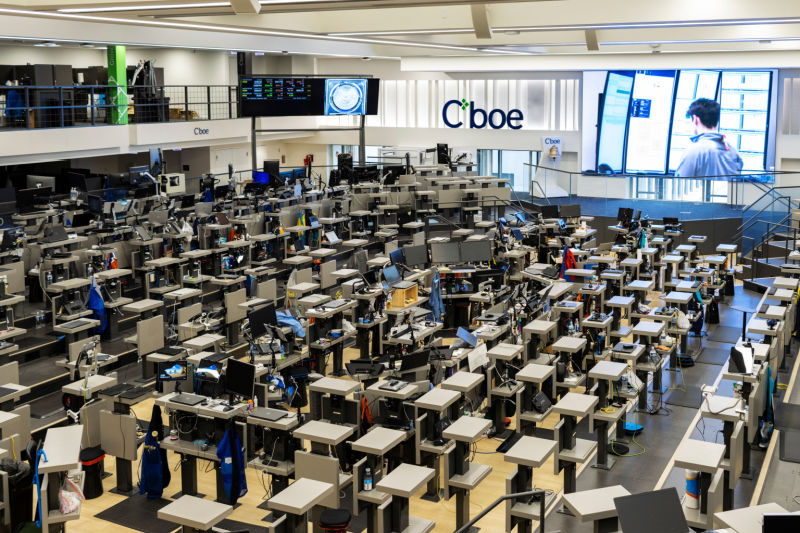
Cboe launched daily expiring Dow Jones Industrial Average options (DJXW), expanding the menu to Monday-Thursday P.M.-settled contracts alongside existing weekly and monthly expirations. The company highlighted strong demand for short-dated index options, with zero-days-to-expiration trading accounting for 50.11% of index options volume in Q1 2026 and DJX open interest exceeding $472 million in notional value. The update also comes alongside a Q1 2026 earnings beat ($3.70 EPS vs. $3.25 expected), revenue of $728.9 million vs. $693.75 million consensus, and a $0.72 quarterly dividend.
This is less a one-off product announcement than a signal that Cboe is trying to own the shortest end of the volatility curve before competitors can normalize the user experience around intraday hedging. Daily-dated index options deepen the exchange’s moat because they are sticky for both retail flow and market-makers: once users build workflows around 0DTE-style hedging, the clearing, margin, and liquidity benefits compound and make it harder for order flow to migrate elsewhere. The second-order winner is likely not just Cboe’s listed-options franchise, but also its data, routing, and market-structure economics as tighter spreads and higher contract turnover improve monetization per active user.
The key risk is that the market is already pricing Cboe as a quality compounder, so the stock can continue higher on operating momentum without offering much multiple expansion. Near-term upside depends more on sustained volume acceleration than on the product launch itself, which means the trade can stall if post-event volatility cools or if equity markets shift from frantic hedging to lower realized vol. Over a multi-quarter horizon, the real test is whether the new expiries lift total incremental notional or simply cannibalize Friday/monthly contracts; if it is mostly substitution, the headline growth may overstate net economics.
The broader read-through is bearish for complacency across the ecosystem: more daily expiries usually mean more dealer hedging around macro events, which can amplify intraday moves and increase demand for risk management tools at the exact moments investors least want exposure. That is constructive for exchange operators and selected market-making/retail-brokerage infrastructure names, but it is a negative for investors assuming lower-fee, lower-friction trading will reduce volatility. The consensus likely underestimates how much persistent short-dated flow can support exchange volumes even in a sideways tape, making this a structural rather than cyclical revenue enhancer.
AI-powered research, real-time alerts, and portfolio analytics for institutional investors.
Request DemoOverall Sentiment
mildly positive
Sentiment Score
0.45
Ticker Sentiment
