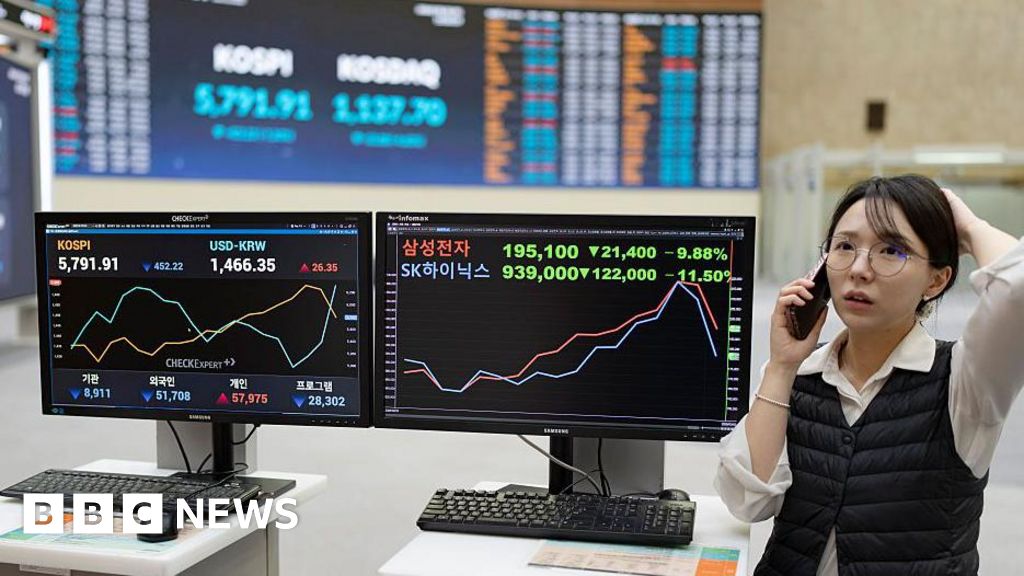
Asian equity markets turned sharply risk-off as geopolitical escalation in the Middle East drove energy prices higher and disrupted shipping through the Strait of Hormuz. South Korea's Kospi fell about 3.7% in early trade after a more than 7% drop on Tuesday, Japan's Nikkei 225 was down ~2.3% and Australia's ASX 200 fell ~1.5%, while Brent and US-traded crude were up roughly 0.5% after two days of surging prices. Attacks on vessels near the shipping lane and threats from Iran that have nearly halted traffic — combined with U.S. assurances from President Trump that the Navy will protect ships and offer risk insurance — are heightening market volatility and posing a material near-term risk to global energy supply and equity market sentiment.
Market structure: Energy producers and tanker owners are immediate winners while oil-sensitive consumption sectors (airlines, container shipping, tourism-facing leisure) are losers; expect XOM/CVX and tanker names (FRO, INSW) to see pricing power if Brent sustains >$90/bbl over 2–6 weeks, while airline margins compress ~5–15% per $10 move in jet fuel. Supply/demand: a partial closure or insurance-driven rerouting raises delivered costs and effectively tightens global seaborne oil capacity by 10–20% near-term, creating upward pressure on spot curves and backwardation in crude futures.
Risk assessment: Tail risks include a full Strait of Hormuz blockade (low probability, >$130/bbl oil, global recession trigger) and escalation prompting sanctions/disruption to shipping insurance markets; immediate (days) volatility spikes, short-term (weeks) energy re-pricing, and long-term (quarters) potential demand destruction if prices stay >$110. Hidden dependencies: freight insurance, naval escorts, and alternative pipeline throughput are underwriting the real risk — watch insurance rate announcements and charter rates as leading indicators. Key catalysts: Iranian escalation, US naval deployments, OPEC spare-capacity announcements, and weekly EIA inventory prints.
Trade implications: Favor cash energy longs and call exposure to majors (XOM/CVX) and specialist tankers (FRO/INSW) for 1–6 months; short airlines and JETS ETF for immediate delta to rising fuel. Use options to monetize convexity: buy 1–3 month call spreads on XOM/CVX or 2× long Brent-call spreads and buy SPY 1-month protective puts or VXX call spreads to hedge tail risk. Sector rotation: shift 3–7% from EM/Asia cyclicals (EWY, EWJ caution) into energy, defense (LMT, NOC) and gold (GLD) over next 4–12 weeks.
Contrarian angles: Consensus risk-off may overshoot — if Brent rallies <15% and insurance/US naval protection stabilizes routes, shipping reroutes and demand elasticity could snap oil back; this makes short-dated, defined-risk option buys (30–90 day) superior to outright long equities. Look for oversold Korean/ Japanese exporters with limited energy exposure as 4–8 week mean-reversion candidates if geopolitical headlines cool; don’t chase long-duration cyclical longs until crude confirms a new regime (>95–100 for 6+ weeks).
AI-powered research, real-time alerts, and portfolio analytics for institutional investors.
Request TrialOverall Sentiment
strongly negative
Sentiment Score
-0.60
