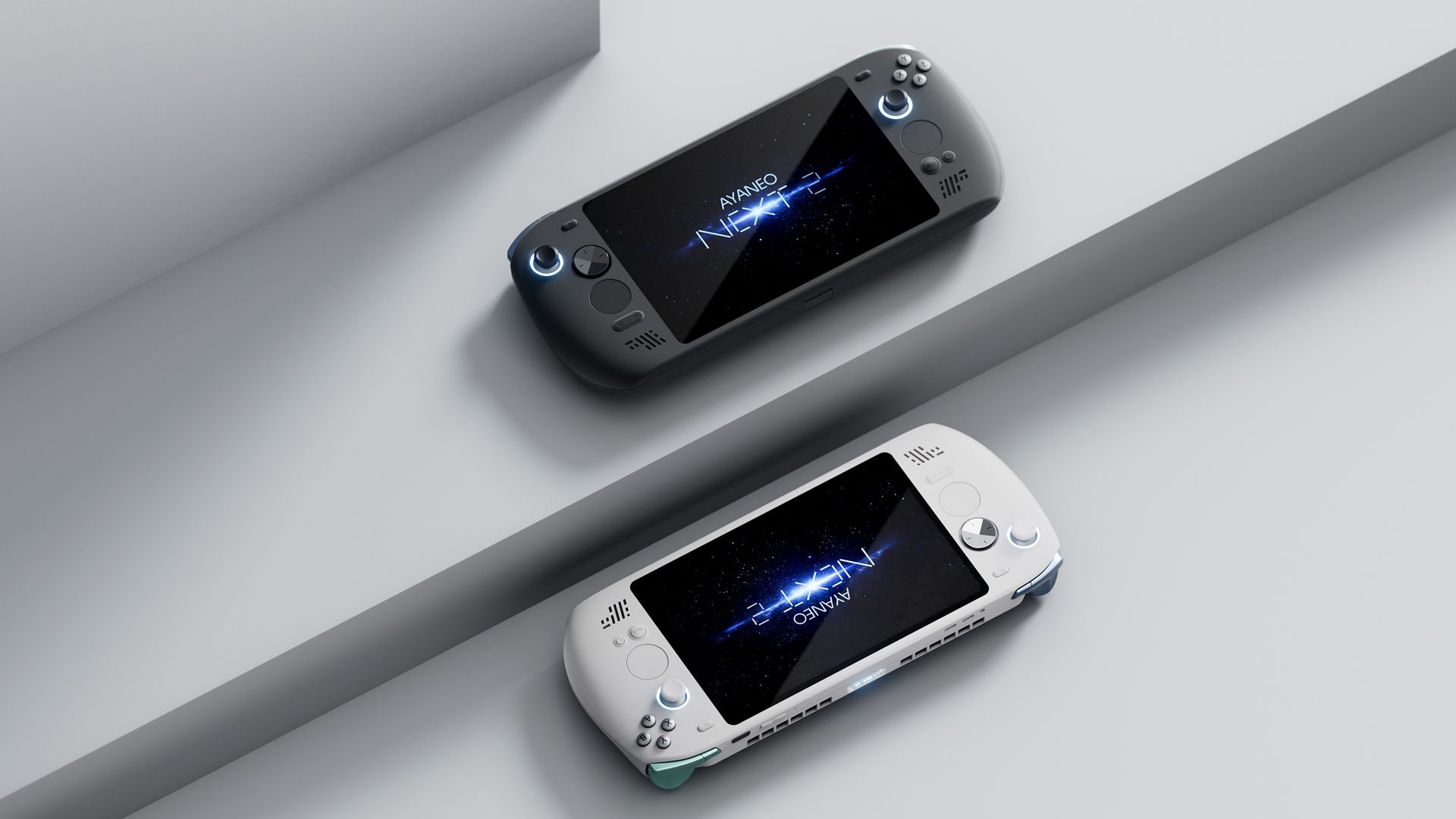
Ayaneo has started Indiegogo preorders for the Next II Strix Halo handheld, offering AI Max+ 395 and AI Max 385 configurations with early-bird pricing: AI Max+ 395 (128 GB RAM / 2 TB storage) $3,499 early bird ($4,299 retail); 395 (64 GB / 1 TB) $2,299 early bird ($2,699 retail); AI Max 385 (32 GB / 1 TB) $1,799 early bird ($1,999 retail). The Next II differentiates itself with a large 116 Wh internal battery (potentially airline-restricted), a 9.06-inch 2400 x 1504 OLED (60–165 Hz, 1,155 nits), and Ryzen AI hardware (8 cores/16 threads, up to 5.0 GHz, 45–120 W TDP) with Radeon 8050S graphics; compared with GPD and OneXPlayer, Ayaneo’s unique internal battery and higher memory options justify a premium but may constrain demand given steep pricing.
Market structure: This launch reinforces AMD's (supplier of the Ryzen AI Max+ 395) emerging advantage in high-performance mobile AI silicon—winners are AMD (chip revenue + OEM design wins) and DRAM suppliers (higher memory SKUs: 32–128GB). Losers: Intel (INTC) faces pressure in the handheld/mobile AI pre-announcement window and small OEMs that rely on external-battery designs may lose pricing power as consumers pay a premium for integrated 116Wh batteries ($300–$1,500 premium). Expect niche segmentation: ultra-premium handhelds (>$2k) at low volumes, mainstream at sub-$2k; pricing power concentrated among OEMs that bundle big batteries and high memory.
Risk assessment: Tail risks include regulatory restrictions on >100Wh batteries (airline/transport bans) that could materially reduce TAM within 0–12 months, and a sudden DRAM supply relief that would compress ASPs (price drop >15% would hurt OEM margins). Immediate (days) effect: limited; short-term (1–6 months): order-book signals and Intel announcements; long-term (6–24 months): platform wins drive silicon share shifts and DRAM content per device. Hidden dependency: success depends on sustained consumer willingness to buy high-priced handhelds amid broader gaming spend softness.
Trade implications: Direct plays: long AMD and MU (DRAM upside) while tactically underweight INTC. Use options: buy 6-month AMD 10% OTM call / sell 25% OTM call (call spread) sized as defined risk to capture adoption news; consider MU 3–9 month call spread for DRAM tail. Pair trade: long AMD (2–3% portfolio) vs short INTC (1–2%) to play mobile AI share shift; take profits if AMD outperforms >20% or Intel announces competing product within 90 days.
Contrarian angles: Consensus overweights the narrative that internal batteries are decisive—if regulators curtail >100Wh batteries or consumers reject >$2k price points, the premium evaporates and component-rich OEMs face margin compression. Historical parallel: high-end portable console booms (e.g., GPD early models) that saw limited market expansion once price elasticity hit; mispricing risk: MU and AMD already price in optimistic adoption—watch DRAM spot decline >15% or a 90-day Intel roadmap reveal as catalysts to reverse positions.
AI-powered research, real-time alerts, and portfolio analytics for institutional investors.
Request DemoOverall Sentiment
mildly positive
Sentiment Score
0.25
Ticker Sentiment
