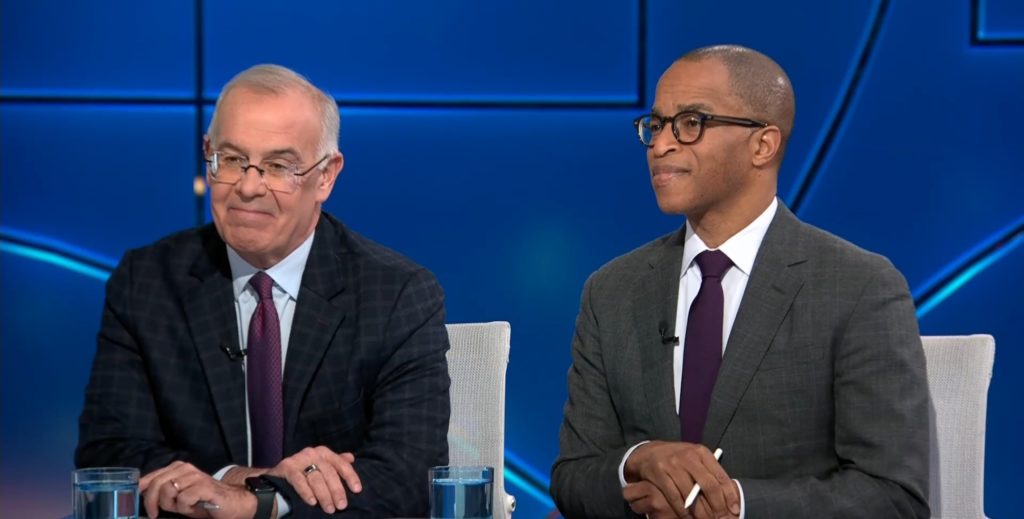
Commentators flagged elevated geopolitical risk as the Russia‑Ukraine war nears its fourth year—citing a recent large Russian drone barrage, a Zelenskyy–Trump meeting and a reported peace plan described as '90% ready'—but expressed skepticism that Putin would accept concessions or that the U.S. under President Trump can provide reliable security guarantees. Domestically, Trump issued his first vetoes of the second term (including a $555,000 Colorado water project and tribal land protections), raising concerns about political retribution and policy unpredictability; panelists also highlighted market-relevant themes to watch in 2026 such as Europe's ability to back Ukraine without firm U.S. commitments, China's industrial momentum, and the potential labor‑market effects of AI.
Market structure: Continued uncertainty around Ukraine peace talks benefits defense primes (LMT, NOC, RTX) and commodities-linked energy names (XOM, CVX) as short-term upside to order books and oil prices is likely; European defense OEMs and construction/materials (CAT, NUE) are secondary beneficiaries if EU spends €30–€100bn on rearmament/reconstruction. Losers include European consumer cyclicals and airlines (AAL, UAL, JETS ETF) from prolonged conflict and supply-chain disruption; FX pressure on RUB and regional EM currencies will persist if sanctions remain. Competitive dynamics favor large US primes for near-term procurement, but a European industrial push could erode US pricing power over 12–36 months.
Risk assessment: Tail risks include a NATO-Russia military escalation (5–10% probability) that could spike Brent >$120 and trigger >15% S&P drawdown, and a rapid negotiated settlement (10–20% probability) that compresses defense revenue forecasts 10–20% over 12–18 months. Immediate volatility (days) will follow any major negotiation headline; weeks–months hinge on EU/US funding decisions; long-term (quarters/years) impact depends on US political reliability and AI-driven demand shifts. Hidden dependencies: US domestic politics (presidential flip-flops, vetoes) materially affect guarantees and aid flows — monitor administration statements and Congressional votes on aid within 30–90 days.
Trade implications: Tactical allocation: overweight defense and energy as asymmetric hedges while buying AI secular champions (NVDA, MSFT) for multi-year growth; use 6–18 month option structures to control drawdown. Pair trades: go long LMT (1–1.5% NAV) vs short JETS or BA (1–1.5%) to capture defense/travel divergence; buy GLD (1–2%) and 3-month STOXX600 puts as tail hedges if crude >$95 or escalation odds exceed 10%. Entry: initiate within 2–6 weeks; exit or rebalance on definitive peace agreement or EU funding >€75bn (re-evaluate within 30 days).
Contrarian angles: Consensus treats US defense as perpetual winner — market underestimates a coordinated European buildout that could reduce US export upside by 15–25% over 2–3 years; don’t overpay for premium defense multiples. Peace-surrender scenario is underpriced in some names; reconstruction exposure (CAT, CRH.L) could outperform if negotiations advance — consider switching part of short-duration defense exposure into materials on confirmed €50bn+ reconstruction commitments. Unintended consequence: Trump administration unpredictability can flip flows in days — prefer liquid ETFs and option-defined risk structures rather than large directional levered bets.
AI-powered research, real-time alerts, and portfolio analytics for institutional investors.
Request DemoOverall Sentiment
neutral
Sentiment Score
-0.10
Ticker Sentiment
