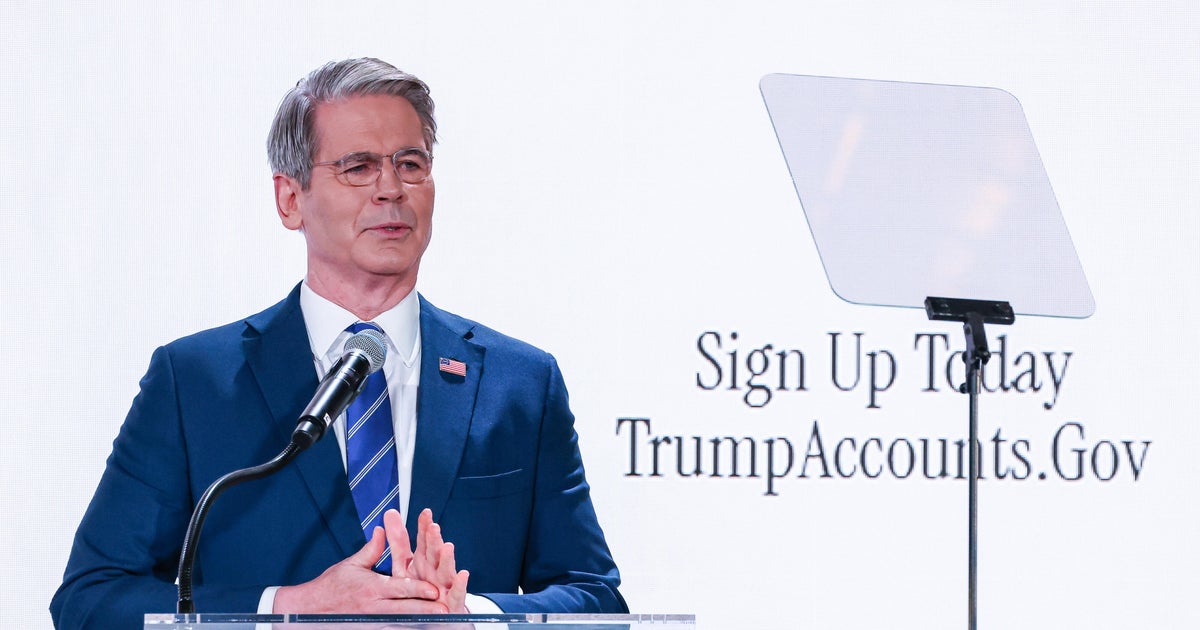
Treasury Secretary Scott Bessent promoted the Trump administration's new program that will open tax-preferred, government-seeded investment accounts for roughly 25 million children born Jan. 1, 2025–Dec. 31, 2028, with $1,000 per child invested in index funds and a $5,000 annual contribution limit; the program has drawn about 600,000 signups this week and philanthropists Michael and Susan Dell have pledged $250 per child (a $6.2 billion commitment excluding the wealthiest 20% of zip codes), while Bank of America and JPMorgan Chase said they will contribute $1,000 to accounts opened by their employees. Bessent defended the initiative against claims it would widen wealth gaps, framed it as promoting long-term market participation and financial literacy, and also used the interview to criticize current inflation trends and urge Fed accountability amid a DOJ probe of Chair Jerome Powell.
Market structure: The program creates an immediate, quantifiable liquidity injection — ~$25 billion of seed capital (25M children × $1,000) flowing into equity index funds now and recurring flows if parents/employers contribute (conservative estimate: $5–15B/year if average $200–$600/year). Winners are large custodians/asset managers and ETF issuers (scale/custody fee capture); regional banks and small custodians lose share and pricing power. The program modestly supports US equity demand (roughly a 0.2–0.5% lift to US ETF AUM initially) while reducing short-term cash/deposit growth for non-custodial products.
Risk assessment: Tail risks include a political/regulatory reversal, operational/custody failures, or a market drawdown that causes reputational/policy backlash; any of these could reverse flows within 3–12 months. Immediate market reaction (days–weeks) is shallow positive for BAC/JPM; medium term (3–12 months) depends on enrollment cadence and corporate match announcements; long-term effects (years) hinge on cumulative contributions and asset allocation decisions. Hidden dependencies: uptake rate, average contribution, and asset-allocation to equities vs. bonds — small percentage changes in uptake (±10%) move annual flows by billions.
Trade implications: Tactical long exposure to large custodial banks (JPM, BAC) and large ETF/asset managers (BLK, IVV/VOO exposure) captures fee and flow upside; favor scale winners over regionals (short KRE). Use cost-controlled options to lever upside (3–9 month call spreads). Reduce exposures to pure consumer-credit franchises vulnerable to a 10% APR cap (e.g., COF, SYF) until legislative risk is resolved (90 days).
Contrarian angles: Consensus underestimates the political fragility — a significant market drawdown (S&P down >15% in 6 months) could convert program goodwill into political pressure and forced reallocation away from equities. Historical parallel: UK Child Trust Funds produced long-term retail engagement but negligible short-term market disruption; here the headline $25B is meaningful to ETFs but not systemic. Watch for unintended consequence of widening wealth gaps (high-income families maxing $5k) that could spur targeted donations or regulatory change within 1–3 years.
AI-powered research, real-time alerts, and portfolio analytics for institutional investors.
Request DemoOverall Sentiment
mildly positive
Sentiment Score
0.12
Ticker Sentiment
