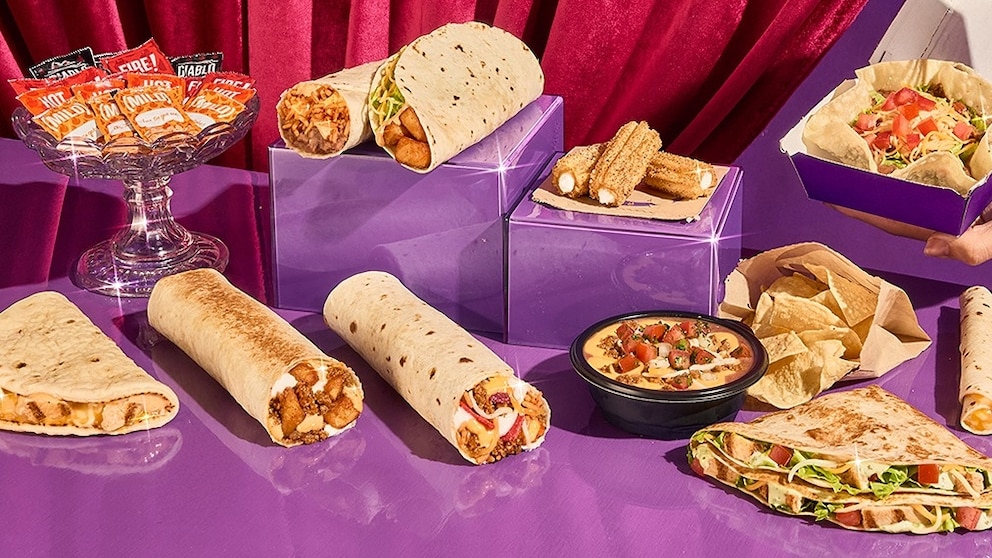
Taco Bell will launch a new Luxe Value Menu on Jan. 22 featuring 10 items priced under $3 (five new items including Salted Caramel Churros, Loaded Griller and Avocado Ranch Chicken Stacker, plus five customer favorites), with exclusive early access for Rewards members on Jan. 16. The initiative, positioned to drive additive "add-on" transactions and capture price-sensitive consumers (and rising chicken demand), reflects a strategic product-and-pricing push that may modestly lift traffic and per-visit spend but is unlikely to produce material near-term moves in the company’s stock.
Market structure: Taco Bell’s Luxe Value Menu is a targeted price-led initiative that should disproportionately benefit Yum! Brands’ Taco Bell unit (YUM) via higher visit frequency and add-on penetration; model a plausible 0.5–2.0% systemwide comp lift concentrated in the 3–6 month window if add-on attach rises by 3–5 percentage points. Suppliers of chicken and potato products (e.g., TSN, LW) see modest incremental demand; competing value-focused QSRs (WEN, QSR) face share pressure in the low-price bracket while premium players (MCD) are less exposed.
Risk assessment: Tail risks include a food-safety recall, franchisee revolt over margin sharing, or a simultaneous spike in input costs (chicken +10% W/W) that compresses margins; any of these could knock 10–20% off short-term profitability for affected restaurants. Immediate effects (days) are marketing noise; short-term (weeks–months) will show traffic and loyalty lift; long-term (quarters) depends on franchise economics and potential menu complexity-driven throughput degradation.
Trade implications: Direct long YUM exposure is the highest-conviction play to capture traffic lift and loyalty monetization; consider options to cap downside while keeping upside. Relative trades: long YUM vs short WEN or QSR to express value-share capture. Watch Jan 16 loyalty sign-up metrics and the first 30-day AUV read as primary catalysts to scale positions.
Contrarian angles: Consensus likely underappreciates franchisee pushback and operational friction—menu complexity can increase service times and reduce throughput by 1–3% if not executed, offsetting traffic gains. Conversely, investors may underweight digital/loyalty upside: if rewards adoption increases AUV by >1.5% over 90 days, upside can outsize headline margin fears; historical Taco Bell value launches show limited long-term margin damage but recurring short-term traffic spikes.
AI-powered research, real-time alerts, and portfolio analytics for institutional investors.
Request DemoOverall Sentiment
mildly positive
Sentiment Score
0.35
