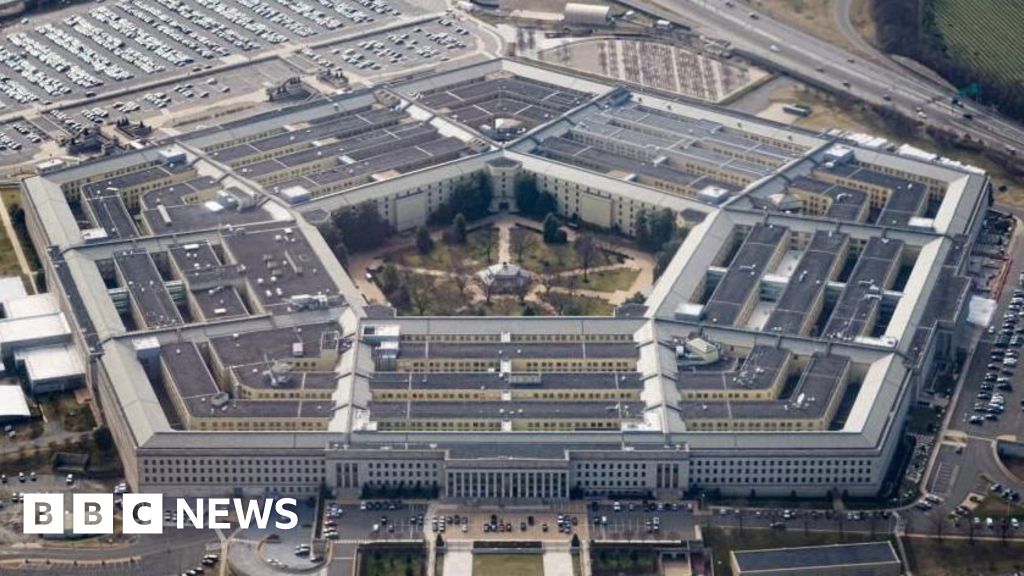
The Pentagon's new 34-page National Defense Strategy shifts priority away from China toward defending the US homeland and Western Hemisphere, signaling more limited support for allies and greater burden-sharing. The strategy pledges to guarantee US military and commercial access to key terrain (notably the Panama Canal, Greenland and the Gulf of America), omits explicit mention of Taiwan despite a recent $11bn arms sale, and describes Russia as a "persistent but manageable" threat while scaling back US deterrence roles in Korea. The reorientation could reshape alliance responsibilities and defense demand patterns, with implications for defense contractors, logistics chokepoints and geopolitical risk premia across markets.
Market structure: The Pentagon pivot from China to homeland/Western Hemisphere favors firms with coastal/Arctic logistics, ISR/counter-drone, port security, and cybersecurity exposure (ISR demand shift could lift LHX, TDY, CRWD). Export-oriented platform makers whose revenue relies on expeditionary power projection (certain naval/air prime programmes) face slower order growth; expect pockets of capex reallocation over 12–36 months. In cross-asset terms, shorter-term safe-haven flows should support USD and core Treasuries, while multi-year deficit-funded homeland programs put upside pressure on long yields and defense-related equities.
Risk assessment: Tail risks include a misstep over Taiwan or sudden China/Russia escalation (low prob. but >$100bn procurement shock) and an alliance fracture that forces rapid rearmament in Europe/Asia. Immediate (days) market moves will be muted; expect procurement RFP signals in 3–9 months and budget reweights over the FY+1 defense bill cycle (12–24 months). Hidden dependencies: contractors with China supply chains (electronic components, rare earths via Greenland mining) may face second-order sourcing shocks.
Trade implications: Favor US homeland-focused defense and cyber names and logistics exposed to Panama/Caribbean routes; de-emphasize large platform exporters to Europe. Implement 6–18 month directional and relative-value trades (see decisions) and use 3–12 month call spreads to capture funding-driven upside while limiting carry. Watch DoD FY+1 budget language and Panama Canal toll/traffic +10% as catalysts.
Contrarian angles: Consensus assumes blanket defense upside; the market is underpricing winners with domestic-security centric product lines and overpricing traditional power-projection primes whose order books are long-dated. Historical parallel: post-9/11 shift favored homeland security vendors versus big-ticket platforms for several years—this time around expect similar ~20–40% relative re-rating within 12–36 months if procurement follows language. Unintended consequence: increased allied burden-sharing could accelerate European domestic arms markets, creating competition for US exporters.
AI-powered research, real-time alerts, and portfolio analytics for institutional investors.
Request DemoOverall Sentiment
mildly negative
Sentiment Score
-0.25
