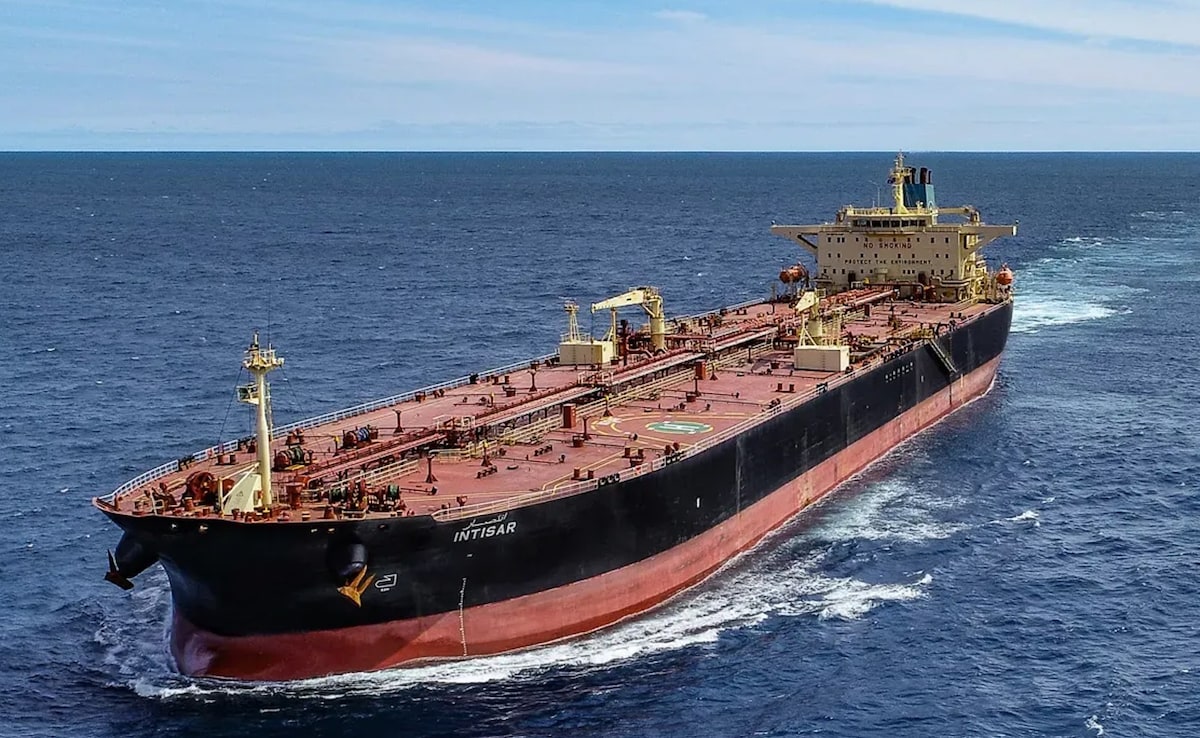
Ping Shun, a US-sanctioned Aframax carrying roughly 600,000 barrels of Iranian crude, rerouted mid-voyage from Vadinar, India to Dongying, China after previously declaring an April 4 ETA to Vadinar. Kpler and market sources say the move appears payment-driven as sellers tighten terms from 30–60 day credit toward upfront/near-term settlement; the US issued a 30-day at-sea waiver expiring April 19 and Iran remains cut off from SWIFT. With an estimated 95 million barrels of Iranian oil afloat (about 51 million barrels potentially suitable for India), the episode underscores that financial/counterparty constraints — not logistics — are likely to redirect volumes toward China and Southeast Asia, with modest tightening of regional crude availability and price sentiment possible.
The mid-voyage reroute is a liquidity/settlement shock that converts what would have been a logistics story into a finance-driven allocation problem — cargoes are now effectively fungible to the buyer that can pay on the seller’s tightened terms. Expect a near-term bifurcation: counterparties with state-backed or sanctioned-proof payment rails (Chinese refiners/trading houses) gain optionality while commercial buyers reliant on correspondent banking and credit windows (many Indian refiners and smaller trading houses) face loading risk and premium erosion. This will increase the marginal value of barrels to RMB- or non‑SWIFT-capable buyers and compress the pool of credible purchasers, raising regional price dispersion and backwardation for Iran-sourced grades over the next 2–8 weeks.
Second-order: rerouting increases tanker ballast times, insurance friction and voyage unpredictability, pushing spot Aframax/Suezmax time-charter equivalent (TCE) rates higher and shortening effective refinery access windows for importers. For Indian refiners unable to secure upfront settlement, substitute supply will come from the Middle East and US Gulf, creating transient shifts in VLCC scheduling and potentially widening freight spreads between ME→IN and ME→CN legs. Politically, the April 19 waiver cliff is the key catalyst — a waiver extension or a bilateral payment channel would quickly reverse these frictions; enforcement actions or non-extension will entrench the new flows.
Near-term market implications (days–months): expect improved margins for Chinese coastal refiners that can take discounted Iranian barrels and higher tanker freight/insurance premia. Watch bank messaging from India and China and any discreet FX arrangements (RMB settlement corridors) — those are the mechanisms that will determine whether the current pattern persists or reverts within one to three months.
AI-powered research, real-time alerts, and portfolio analytics for institutional investors.
Request DemoOverall Sentiment
neutral
Sentiment Score
0.00
