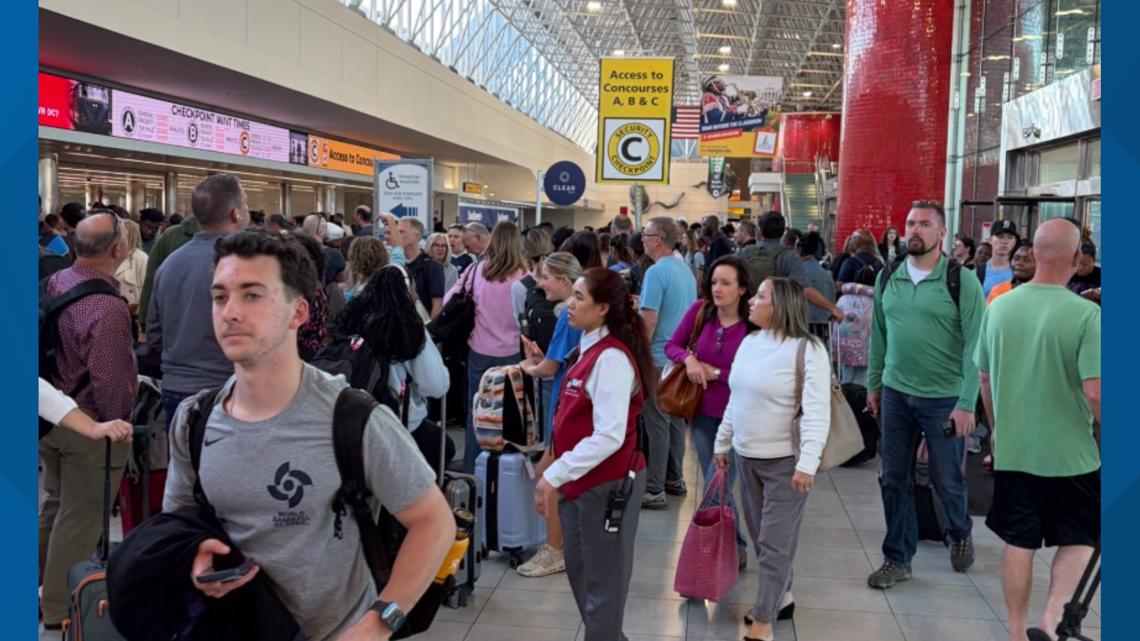
Two security checkpoints (A and B) were closed at BWI, prompting the airport to advise travelers to arrive three hours before departure due to long TSA lines. The disruption occurs amid a partial government shutdown during which TSA employees are working without pay, more than 300 agents have quit and sick calls have more than doubled. President Trump announced ICE agents will begin assisting TSA officers starting Monday, a potential short-term staffing response to the operational strain.
Immediate operational pressure to US airport throughput is a direct multiplier on airline unit costs: understaffed checkpoints raise misconnects, rebooking, and irregular-operation (IRROPS) costs that manifest as higher CASM-ex (fuel) for carriers with tight turns and point-to-point fleets. Expect the incremental cost per disrupted flight to be front-loaded over days but compounding if the staffing gap endures beyond 1–2 weeks because attrition and sick-call amplification force overtime and contract labor premiums.
Second-order winners and losers diverge by network structure and ancillary revenue exposure. Point-to-point low-cost carriers with minimal schedule slack are most likely to realize outsized seat-cost hits and reputational flight cancellations; hub-and-spoke legacy carriers absorb shocks better via re-accommodation but take a short-term hit to yield from goodwill fares and reissue costs. Vendors tied to federal contracts (IT/security staffing and software for DHS/ICE) and airport concessionaires will see countervailing flows: higher federal spend for stopgaps and mixed retail outcomes depending on whether delays increase dwell-time spend or accelerate gate-skipping behavior.
Key catalysts and monitoring hooks: weekly TSA callout/attrition data, DHS emergency directives, and airline IRROPS reports — if the shutdown persists >2 weeks expect a measurable 1–3% traffic/seat-factor drag for carriers in the following quarter and a potential 5–10% relative underperformance for tight-turn operators. A negotiated funding patch or rapid federal augmentation (details, scope, and duration) would quickly unwind the trade; conversely, protracted gridlock elevates operational insolvency risk for niche regional contractors and smaller LCCs.
AI-powered research, real-time alerts, and portfolio analytics for institutional investors.
Request DemoOverall Sentiment
mildly negative
Sentiment Score
-0.25
