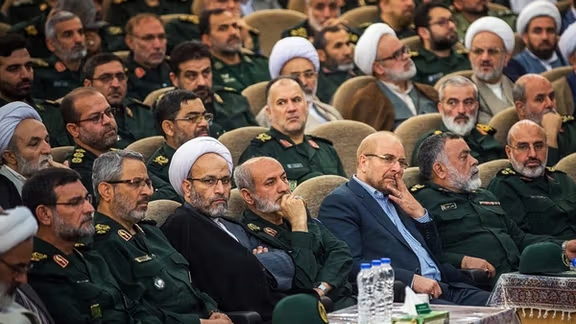
Key event: IRGC hardliner Mohammad Bagher Zolghadr was appointed to head Iran’s Supreme National Security Council after Ali Larijani’s killing, amid reports Iran has now targeted 13 countries in the current conflict. Iran is reportedly monetizing control of the Strait of Hormuz—charging roughly $2M per tanker and advocating a notional $50/ barrel levy—raising the energy/shipping risk premium. Implication: elevated risk of wider regional escalation, higher oil and insurance premia, and a near-term risk-off move across markets driven by supply disruption concerns.
Consolidation of military control at the center of an asymmetric-state apparatus creates a predictable economic incentive: extract recurring rents from chokepoints rather than trigger an all-or-nothing blockade. That dynamic favors a sustained regime of elevated transit costs, spot-route disruption and selective escalation that keeps trade flowing while capturing value — a pattern that is easier for markets to price over months than for crisis scenarios to resolve in days.
Market mechanics will be dominated by three plumbing effects: (1) sharp repricing of route-specific war-risk and P&I premiums, (2) higher time-charter equivalent (TCE) rates as tonnage is reallocated or voyages lengthen, and (3) increased use of non‑bank settlement channels that raise counterparty and compliance risk for commodity traders. Together these push freight and delivered hydrocarbon breakevens modestly higher (order-units: single-digit $/bbl delivered), compress refined-product arbitrage windows, and create structurally higher carry in tanker economics for the next 3–12 months.
Tail outcomes remain asymmetric. A full, days‑long physical closure of the chokepoint would create a rapid oil-price spike (tens of $/bbl) and trigger immediate political retaliation; conversely, credible, low‑cost de‑escalation channels — covert intermediaries or tacit commercial arrangements — would strip most of the premium within weeks. Consensus is likely underweight the “monetize-and-manage” steady-state: markets are pricing headline risk, not the profitable middle path where tanker owners and brokers capture recurring margin while global supply tightness increases only incrementally.
AI-powered research, real-time alerts, and portfolio analytics for institutional investors.
Request DemoOverall Sentiment
strongly negative
Sentiment Score
-0.75
