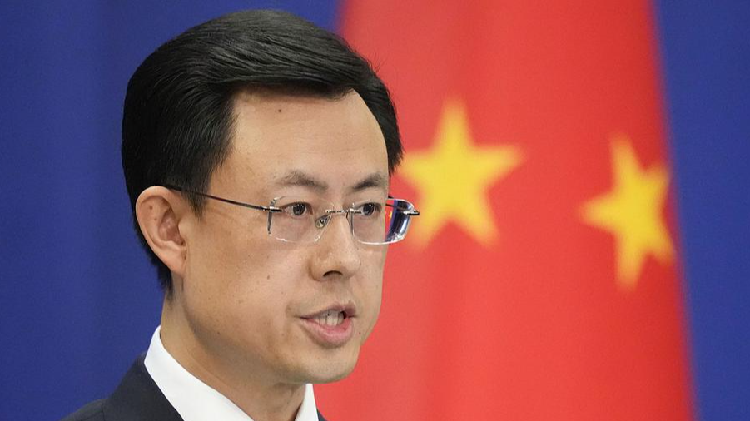
China publicly rebuked recent Japanese comments advocating nuclear armament, with Foreign Ministry spokesperson Guo Jiakun warning that such rhetoric reflects a right‑wing push to revive militarism and ‘remilitarize’ Japan. Beijing urged Tokyo to heed international law and Japan’s constitution, and to reflect on historical wartime conduct ahead of the 80th anniversary of World War II victory; the exchange heightens regional geopolitical risk that could modestly influence defense-sector equities, FX safe‑haven flows and investor sentiment toward East Asia.
Market structure: Escalatory rhetoric around Japanese nuclear options is a small but nonlinear shock that benefits defense contractors (Lockheed Martin LMT, Northrop Grumman NOC, BAE BAES.L) and domestic Japanese defense primes (Mitsubishi Heavy 7011.T, Mitsubishi Electric 6503.T) via expected orderbacklogs +5–15% over 6–18 months. Losers include Japan-exposed cyclical exporters and regional tourism/consumer names if bilateral trade frictions rise; expect near-term safe‑haven flows into JPY and gold and medium‑term upward pressure on JGB yields as fiscal/military spending rises.
Risk assessment: Tail risk—actual Japanese nuclearization—is low (5–10%) but high impact (trade/supply‑chain shock, US alliance recalibration) on a 1–3 year horizon. Immediate (days) effect: modest risk‑off volatility; short term (weeks–months): repricing in defense equities and FX; long term (quarters–years): structural demand for munitions, shipbuilding, and domestic supplier onshoring. Hidden dependencies: US policy signaling, Taiwan contingency, and China’s economic retaliation could amplify effects.
Trade implications: Tactical: overweight western and Japanese defense names with 3–12 month horizon, hedge regional equity exposure with 1–3 month put protection on EWJ; commodity plays in uranium (URA or SRUUF) and GLD as geopolitical hedges. Cross‑asset: expect JPY appreciation in risk‑off (trade JPY vs AUD/GBP), and widening Asia credit spreads—buy CDS protection selectively if exposure >2% of NAV.
Contrarian angles: Consensus understates fiscal multiplier: a sustained LDP push to remilitarize would drive multi‑year capex that markets underprice today (defense outperformance historical excess return ~+5–10% in 12 months after escalation). Reaction is likely underdone in defense names and overdone in immediate panic on JPY/gold; primary unintended consequence is accelerated semiconductor onshoring which would benefit industrial CAPEX names and lift prices for specialty metals and logistics services.
AI-powered research, real-time alerts, and portfolio analytics for institutional investors.
Request DemoOverall Sentiment
mildly negative
Sentiment Score
-0.25
