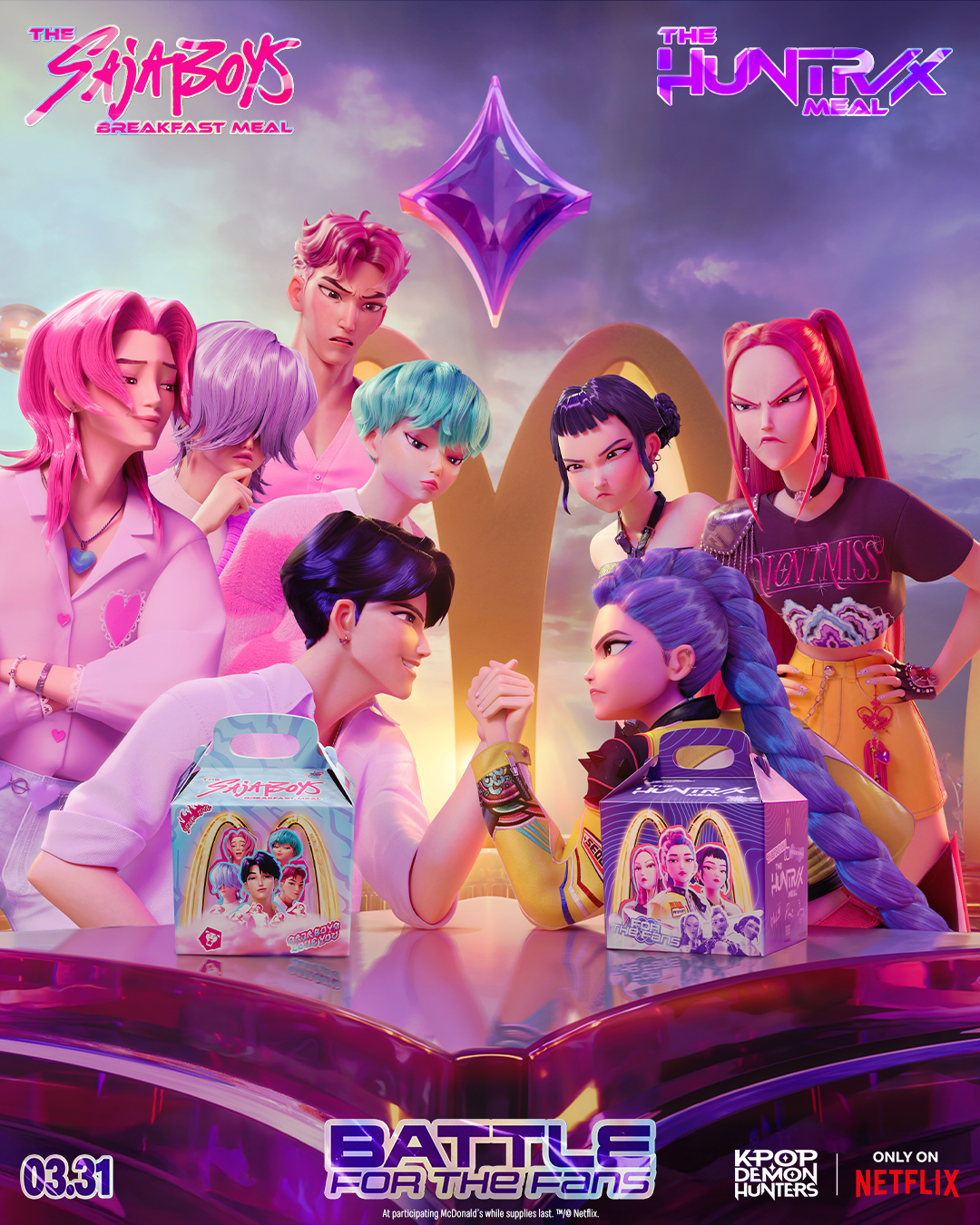
McDonald’s and Netflix are launching a co-branded KPop Demon Hunters promotion starting March 31 with two limited-time meals (Saja Boys Breakfast Meal and HUNTR/X Meal), collectible photocards that unlock first-access content in the McDonald’s app through April 26, and a new Derpy McFlurry. The campaign leverages K‑pop fandom and Korean-inspired flavors to drive short-term foot traffic and incremental sales via restaurants and McDelivery, but is promotional and unlikely to materially affect McDonald’s or Netflix financials or broader market prices.
Fandom-driven, limited-time activations function less as incremental revenue generators and more as low-cost, high-intent acquisition and CRM levers for digital content owners; expect a concentrated 2–6 week spike in installs/DAU among younger cohorts that is high signal for short-term engagement but low dilution to marketing spend. A 1–2 percentage-point lift in retention for the recruited cohort over 3–6 months would meaningfully improve LTV vs. paid channels because incremental acquisition cost here is mostly promotional variable spend rather than paid CPMs.
For quick-serve operators, culturally specific SKUs reallocate footfall across dayparts and geographies and create lumpy demand for specialized ingredients; localized breakfast share gains of 50–150 bps in targeted metros are plausible, but margin impact is ambiguous since promotional mix and one-off ingredient premiums compress mix-adjusted margins. Distributors and niche ingredient suppliers see order volatility: a short, concentrated order surge can lift near-term revenue for wholesalers but also increase working capital and spoilage risk if repetitions don’t follow.
Key reversal risks are operational friction (redemption glitches, supply shortages), rapid novelty decay, or fandom backlash that turns a short-term uplift into a PR drag; these would show up inside days and crystallize as negative social velocity within 1–2 weeks. Measurable balance-sheet impacts (ARPU, foodservice comps, supplier bookings) should appear within one quarter, so trades should be sized for event-duration exposure rather than long-duration fundamental regime change.
Consensus will treat these activations as marketing noise; the actionable edge is to trade the event window with asymmetric instruments and relative-value pairs rather than large directional exposure to long-term fundamentals. Focus on 1–3 month plays calibrated to user-engagement and comp-print cadence, and use small notional option structures or hedged pairs to capture short-term sentiment without overcommitting to a structural thesis.
AI-powered research, real-time alerts, and portfolio analytics for institutional investors.
Request DemoOverall Sentiment
mildly positive
Sentiment Score
0.25
Ticker Sentiment
