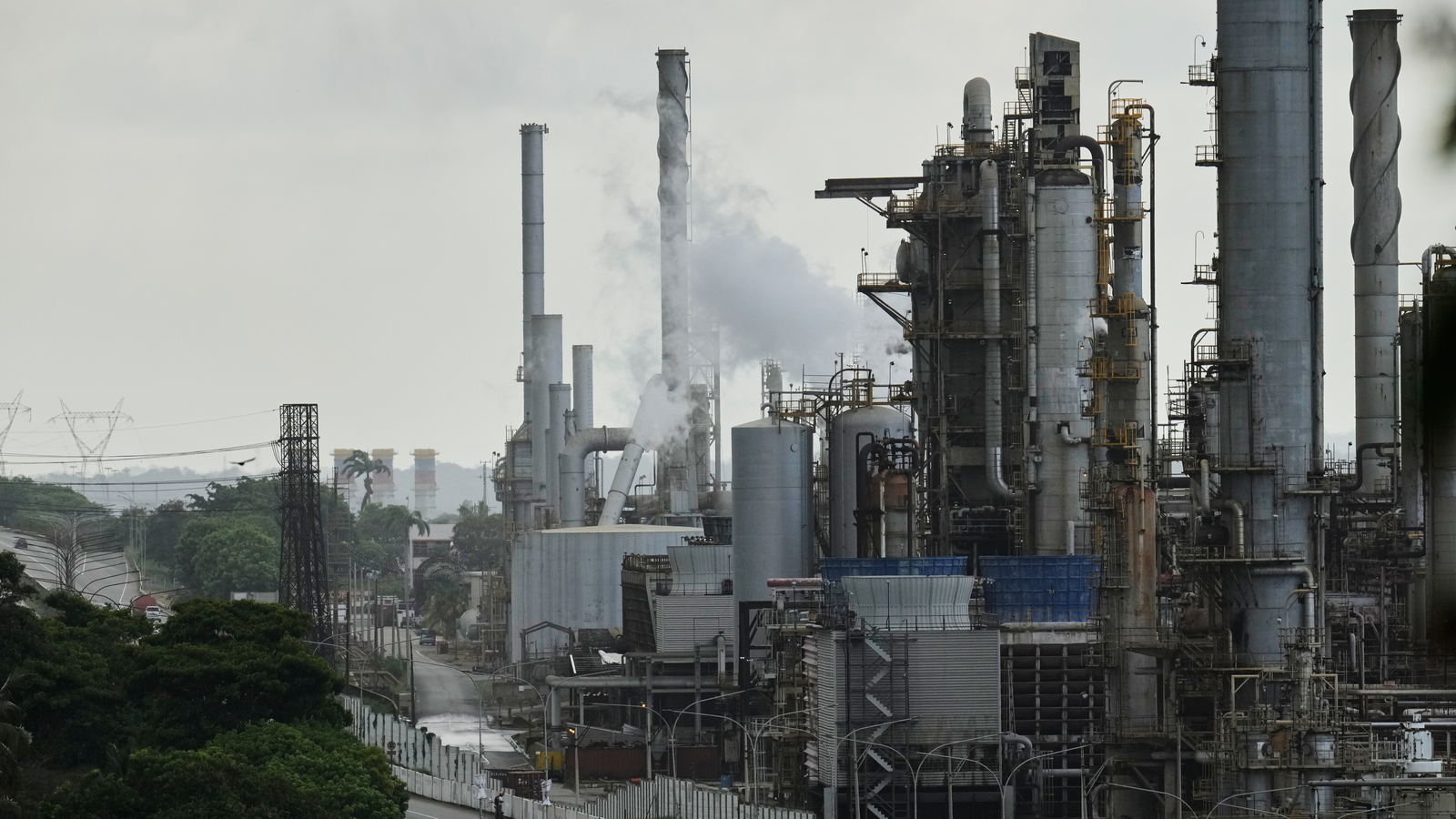
U.S. moves to seize control of Venezuela's oil sector are unlikely to move markets immediately given Venezuela's collapsed production (~1.1 million b/d today versus 3.5 million b/d in 1999) and degraded infrastructure; the country holds ~303 billion barrels of proven reserves (~17% of global reserves). Significant political uncertainty, legal ownership questions and sanctions remain, and industry estimates suggest roughly $100 billion and about a decade would be required to ramp production back toward 4 million b/d, though some analysts say output could double or triple more quickly if investment and stability materialize.
Market structure: Short term winners are companies with existing Venezuelan footprints (Chevron/CVX) and Gulf Coast heavy-crude refiners (e.g., VLO, PBF) because access to heavy crude reduces refinery margins and feedstock costs. Losers: Russian heavy crude suppliers and sanction-sensitive E&P players if takeover triggers protracted legal fights. A recovery of 1–3 mbpd from Venezuela (current ~1.1 mbpd) would equal ~1–3% of global demand — meaningful over years but negligible to markets in days/weeks.
Risk assessment: Tail risks include armed conflict, international legal rulings blocking US control, or renewed sanctions that freeze investment (low probability, high impact). Timeline: immediate (0–30 days) = policy/legal noise and volatility; short-term (1–12 months) = licensing, indemnity negotiations and JV restructuring; long-term (2–10 years) = infrastructure rebuild (~$100bn capex to add ~2–3 mbpd). Hidden dependencies: PDVSA workforce retention, dilapidated downstream upgrader capacity, and insurance/financing availability.
Trade implications: Tactical: favor CVX optionality and Gulf-Coast refiners; avoid broad crude longs until supply data confirms >200 kbpd incremental Venezuelan flows over 3 months. Use pair trades to isolate political execution risk (long CVX / short XOM) and use defined-cost options (12-month call spreads on CVX) to express upside while capping downside. Hedge geopolitical volatility with short-dated WTI straddles sized to institutional risk tolerance.
Contrarian angles: Consensus underestimates legal/operational friction — capital won’t flow at scale without explicit US legal cover and insurer appetite; compare to Iraq (years to normalize production) not Libya (faster). The market may underprice the chance of protracted litigation/asset claims that could leave assets unusable for 1–5 years; a rapid rally in refining names on optimism would be a fade candidate until >500 kbpd sustained output is visible.
AI-powered research, real-time alerts, and portfolio analytics for institutional investors.
Request DemoOverall Sentiment
neutral
Sentiment Score
-0.05
Ticker Sentiment
