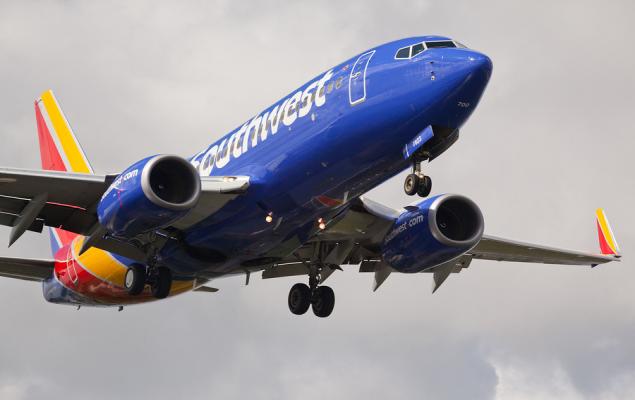
Southwest Airlines reported disappointing Q2 2025 results, with earnings per share of 43 cents missing consensus estimates and declining 25.9% year-over-year, while revenue fell 1.5% to $7.24 billion. This underperformance stemmed from traffic growth failing to keep pace with capacity expansion, reducing the load factor to 78.5%, and a 4.7% increase in unit costs (CASM-X) driven by inflation and labor expenses. Despite these challenges, the airline reaffirmed its full-year incremental EBIT contribution targets of $1.8 billion for 2025 and $4.3 billion for 2026 from strategic initiatives, and returned $1.6 billion to shareholders in Q2, including completing a $2.5 billion share repurchase authorization and approving a new $2.0 billion program.
Southwest Airlines reported a weak second quarter for 2025, with both revenue and earnings falling short of consensus estimates and declining year-over-year. Revenue fell 1.5% to $7.24 billion, while EPS of 43 cents represented a 25.9% YoY drop. The underperformance was driven by a fundamental mismatch between capacity and demand; while available seat miles (ASMs) grew by 1.6%, revenue passenger miles (RPMs) declined by 3.5%, causing the load factor to contract by 4.1 percentage points to 78.5%. This directly pressured unit revenues, with RASM falling 3.1%. Concurrently, non-fuel unit costs (CASM-X) increased by 4.7% due to inflationary pressures and labor contracts, eroding margins despite a 15.9% YoY decrease in fuel costs. In response to these headwinds, management is guiding for Q3 unit revenues to be in a range of down 2% to up 2% on flat capacity, signaling potential stabilization. However, cost pressures are expected to persist, with Q3 CASM-X forecast to rise 3.5-5.5%. Despite the poor operational results, the company is demonstrating confidence through aggressive capital returns, having completed a $2.5 billion share repurchase and authorized a new $2.0 billion program. The viability of this strategy rests heavily on the company achieving its reaffirmed incremental EBIT contribution targets of $1.8 billion for 2025 and $4.3 billion for 2026 from internal initiatives.
AI-powered research, real-time alerts, and portfolio analytics for institutional investors.
Overall Sentiment
moderately negative
Sentiment Score
-0.55
Ticker Sentiment
