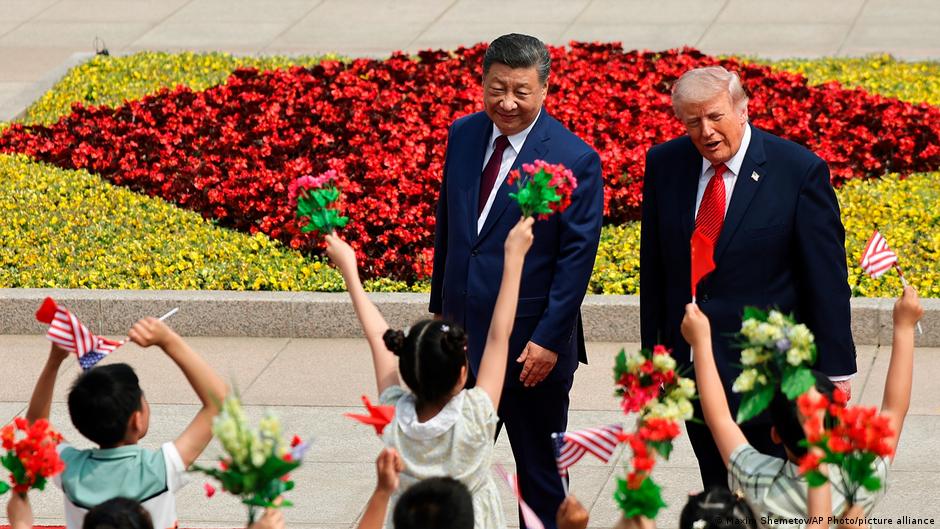
Trump and Xi held 2 hours and 15 minutes of private talks in Beijing, with Taiwan emerging as the key flashpoint. Xi warned that mishandling Taiwan could lead to conflict, while the Chinese readout also said the leaders discussed Ukraine, the Middle East and the Korean Peninsula. The meeting kept trade, tariffs, technology and Taiwan weapons sales in focus, creating elevated geopolitical risk for equities, semis and broader Asia-sensitive assets.
The market implication is less about any single headline and more about the sequencing of concessions. Taiwan is the highest-beta bargaining chip because it can be used to extract movement on trade and tech without requiring immediate legislative action, so the near-term risk is not a formal policy shift but an incremental hardening of language, export controls, and military signaling that compresses multiples on the China-exposed semis first. That makes NVDA the cleanest barometer: even a modest tightening of access or a delayed licensing regime would hit the China revenue mix and, more importantly, revive fears that frontier AI supply chains are becoming structurally bifurcated. A second-order winner is domestic China industrial policy, not because Beijing gains economically from escalation, but because pressure on Taiwan tends to justify faster localization of chips, packaging, and AI compute. Over a 6-18 month horizon, that favors Chinese substitute capacity and hurts premium US hardware names that depend on uninterrupted cross-border demand; the immediate loser is less AAPL/TSLA direct revenue than the valuation multiple attached to their China optionality. For AAPL, the bigger risk is consumer and regulatory retaliation if rhetoric spills into “patriotic purchase” campaigns, which can show up first in channel checks before it appears in reported units. The contrarian read is that the meeting likely reduces tail risk in the next few weeks even as it raises medium-term regime risk. Markets tend to price visible summit diplomacy as de-escalation, but the more important signal is that both sides are now openly using strategic issues as chips, which usually leads to periodic volatility spikes rather than a linear breakdown. In other words, the headline may be mildly negative for equities, but the bigger opportunity is in buying event-driven volatility once the initial relief rally fades and the market refocuses on enforcement details over the next 30-90 days.
AI-powered research, real-time alerts, and portfolio analytics for institutional investors.
Overall Sentiment
mildly negative
Sentiment Score
-0.15
Ticker Sentiment
