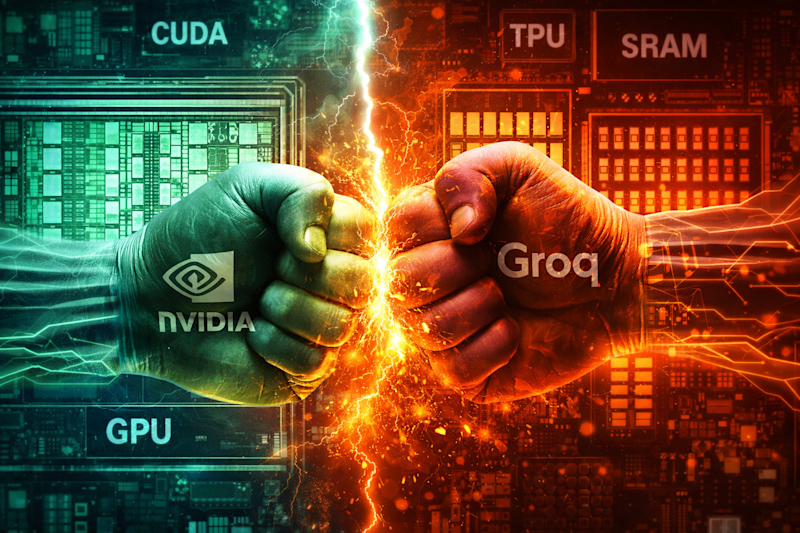
Nvidia struck a roughly $20 billion strategic licensing deal with Groq to integrate Groq’s high-speed inference IP (SRAM-backed LPU) into its inference roadmap, a move framed as both defensive and strategic to protect CUDA dominance as inference workloads fragment. The article cites Deloitte data showing inference surpassed training in data-center revenue in late 2025 and notes Nvidia’s announced Vera Rubin family (Rubin CPX for prefill using 128GB GDDR7) to separate prefill (compute-bound) from decode (memory-bandwidth-bound) workloads. The deal, coming amid Anthropic’s multi-accelerator portability and Meta’s acquisition of Manus (stateful agents/KV cache), signals a market shift to disaggregated inference architectures that will force enterprises to route workloads by latency, context size, and model scale.
Market structure: Nvidia (NVDA) materially strengthens a multi-tier inference stack by licensing Groq IP for low-latency decode while shipping Vera Rubin CPX for prefill; this preserves CUDA’s centrality and fragments demand into SRAM-optimized edge (8B models) and GDDR7/HBM tiers for large-context training. Winners: NVDA (defensive moat), Google (GOOGL) for TPU scale and Anthropic portability, edge/robotics vendors; losers: incumbents dependent on HBM economics and monoculture GPU stacks (INTC exposure via legacy server silicon suppliers).
Risk assessment: Tail risks include antitrust/royalty scrutiny on the $20bn license, Groq integration failure, or a faster-than-expected Pascal-like TPU/software substitution — each could erase multi-quarter guidance; supply risks center on SRAM capacity (manufacturing bulks) and GDDR7 ramp. Timelines: immediate price reaction (days–weeks), product-led revenue mix shift (quarters), structural market fragmentation and revenue reallocation to specialists (2–4 years).
Trade implications: Primary trade is convex exposure to NVDA’s inference monetization — favor 12–24 month LEAPs or concentrated equity with a 3–4% portfolio weight; hedge with modest GOOGL (2%) exposure to TPU/cloud arbitrage and a tactical short/underweight in INTC (1–1.5%) where HBM/legacy CPU demand can compress. Use options to express view: buy NVDA Jan 2027 calls (LEAPs) and sell shorter-dated calls into strength to fund cost.
Contrarian angles: Consensus understates software portability (Anthropic) and overestimates SRAM’s market breadth — much of enterprise spend will slow until orchestration (routing tokens across tiers) is standardized, extending monetization timelines by 6–12 months. Also NVDA’s defensive $20bn outlay risks compressing gross margins if it must subsidize partners; watch adoption metrics (KV cache hit rates, Vera Rubin shipments) before adding exposure beyond the initial allocation.
AI-powered research, real-time alerts, and portfolio analytics for institutional investors.
Request DemoOverall Sentiment
mildly positive
Sentiment Score
0.35
Ticker Sentiment
