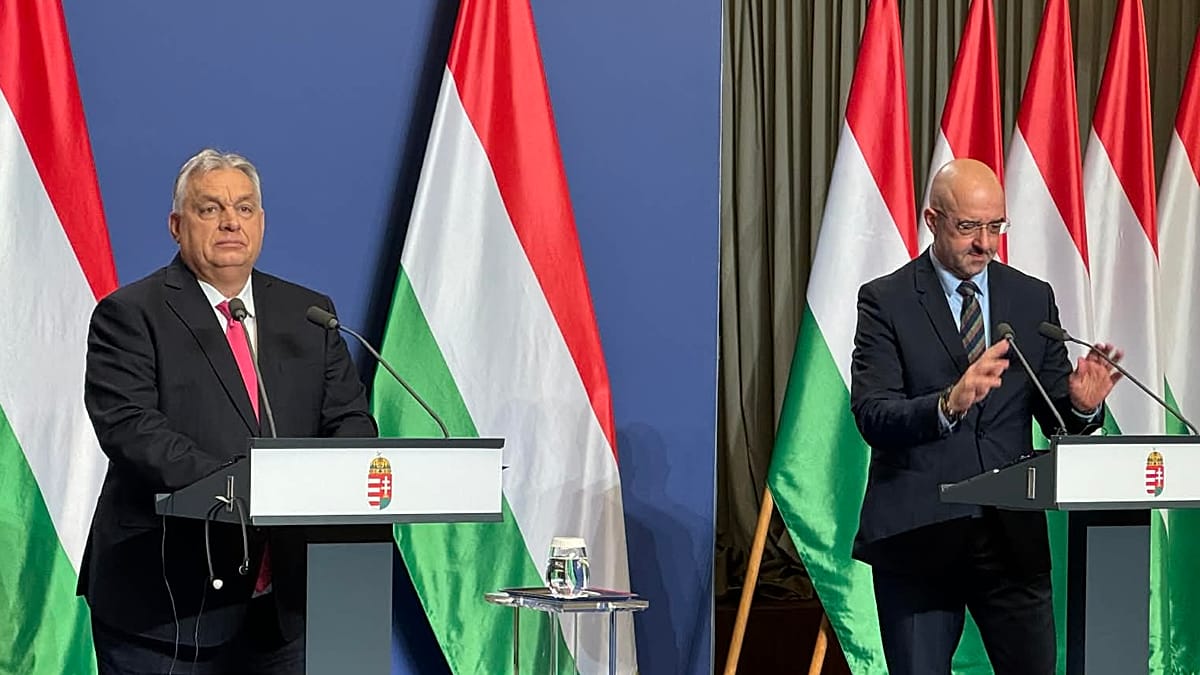
Hungarian Prime Minister Viktor Orbán signalled continued confrontation with Brussels, rejecting funding for Ukraine, defending exemptions on Russian energy imports, and pursuing legal challenges to EU measures while predicting EU fragmentation. He praised the U.S. operation in Venezuela as materially reshaping global oil control (claiming it could influence 40-50% of oil reserves), reiterated refusal to accept EU-mandated migrant allocations, and signalled a sovereign defence posture ahead of April elections as his Fidesz party seeks to replicate its 2022 result. These positions raise political and energy-policy risks for Hungary and EU funding flows, with potential implications for regional political stability and energy market exposure ahead of the vote.
Market structure: Orbán’s public refusal to fund Ukraine, insistence on Russian energy exemptions, and election rhetoric raise the risk premium on Hungarian sovereign credit and FX while creating a narrow winners’ set — domestic energy incumbents (MOL.BU) and Russian exporters — and losers in Hungarian banks (OTP.BU exposure to sovereign and consumer risk), sovereign bonds and any EU-funded capex recipients. If the US-Venezuela development materialises at scale it could add incremental crude supply and put 3–10% downward pressure on Brent over 6–12 months; conversely a hardening of EU-wide Russian energy cuts would tighten TTF gas by 20–50% seasonally and push European utility margins wider.
Risk assessment: Tail risks include a sudden EU escalation that withholds >€5–10bn in funds triggering a 1–2% GDP shock and a 100–200bp move in HU 10y yields (low-prob/high-impact); an April election surprise (Péter Magyar surge or unexpected Fidesz loss) is a 30–60 day catalyst. Immediate (days) moves: HUF weakness and CDS widening; short-term (weeks–months): bank funding stress and yield curve re-pricing; long-term (to 2027): structural realignment if sanctions regime changes or Hungary normalises relations with Russia/US.
Trade implications: Tactical positions: buy 5y Hungary CDS (target 100–200bp widening) or short HU 10y sovereign bonds (size 1–2% NAV) with a 3–12 month horizon; buy EUR/HUF 6M calls 2–3% OTM (0.5–1% NAV) to express HUF downside. Rotate into defensive EU exposures: long Bund futures (or Germany 10y) and GLD (1–2% NAV) to hedge risk-off; short OTP.BU (1% NAV) vs long CE banking ETF exposure only after stress repricing.
Contrarian angles: Markets may overprice a Hungary–EU rupture — full exit is unlikely and exemptions historically bought time; a post-election relief rally could hand back 20–30% of initial HU asset moves. If HU CDS and HUF sell-off exceed 150–200bp/15% respectively, opportunistically scale into long Hungarian equities (OTP.BU, MOL.BU) sized 1–2% NAV with 6–12 month horizon, because past EU funding disputes resolved without existential outcomes (see Greece 2015 mechanics, different but instructive).
AI-powered research, real-time alerts, and portfolio analytics for institutional investors.
Request DemoOverall Sentiment
moderately negative
Sentiment Score
-0.35
