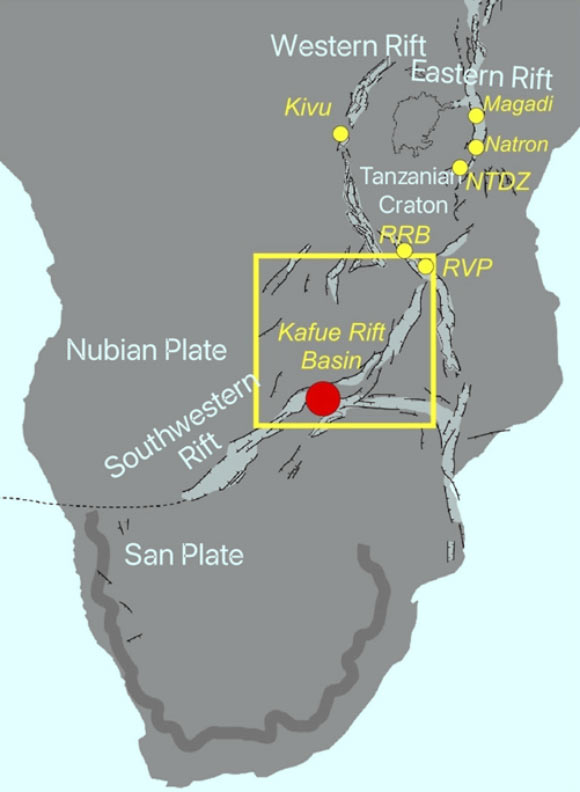
Scientists found mantle-derived helium isotope signatures and elevated carbon dioxide in geothermal springs across Zambia’s Kafue Rift, suggesting the rift may be an early-stage tectonic boundary. The study implies potential long-term implications for the breakup of sub-Saharan Africa, but it is an early-stage geoscience finding based on sampling from one region. Market impact is likely minimal in the near term.
This is not a tradable macro event today, but it is a useful long-duration signal for how capital could reprice around African resource optionality. If the rift system is confirmed as active, the first beneficiaries are not the geologists but the adjacent infrastructure stack: power developers, grid contractors, drilling/service firms, and any operator with exposure to geothermal or gas-to-power siting in southern Africa. The second-order effect is that “country risk” for Zambia and neighbors may compress at the margin if the market starts to view the region as a future energy corridor rather than only a mining jurisdiction.
The more interesting angle is commodities optionality. Mantle-linked fluid flow raises the probability of localized geothermal anomalies, which can matter for base-load power economics over a 3-7 year horizon, but it does not yet imply commercially viable reserve addition. The market should treat this as a real-options catalyst for land, transmission, and EPC names rather than a near-term earnings event; confirmation drilling, grid interconnection, and permitting are the gating items, so any valuation uplift will likely be slow and episodic.
Contrarianly, the consensus may overstate the immediacy while underpricing the strategic value of being early. Similar narratives often get dismissed until a larger resource or infrastructure thesis is formed; by then, access to rights-of-way and sub-surface acreage is already expensive. The downside case is simple: follow-up studies fail to broaden the anomaly beyond a narrow corridor, and the story remains academic, causing any speculative bid to fade within months rather than years.
AI-powered research, real-time alerts, and portfolio analytics for institutional investors.
Overall Sentiment
neutral
Sentiment Score
0.10
