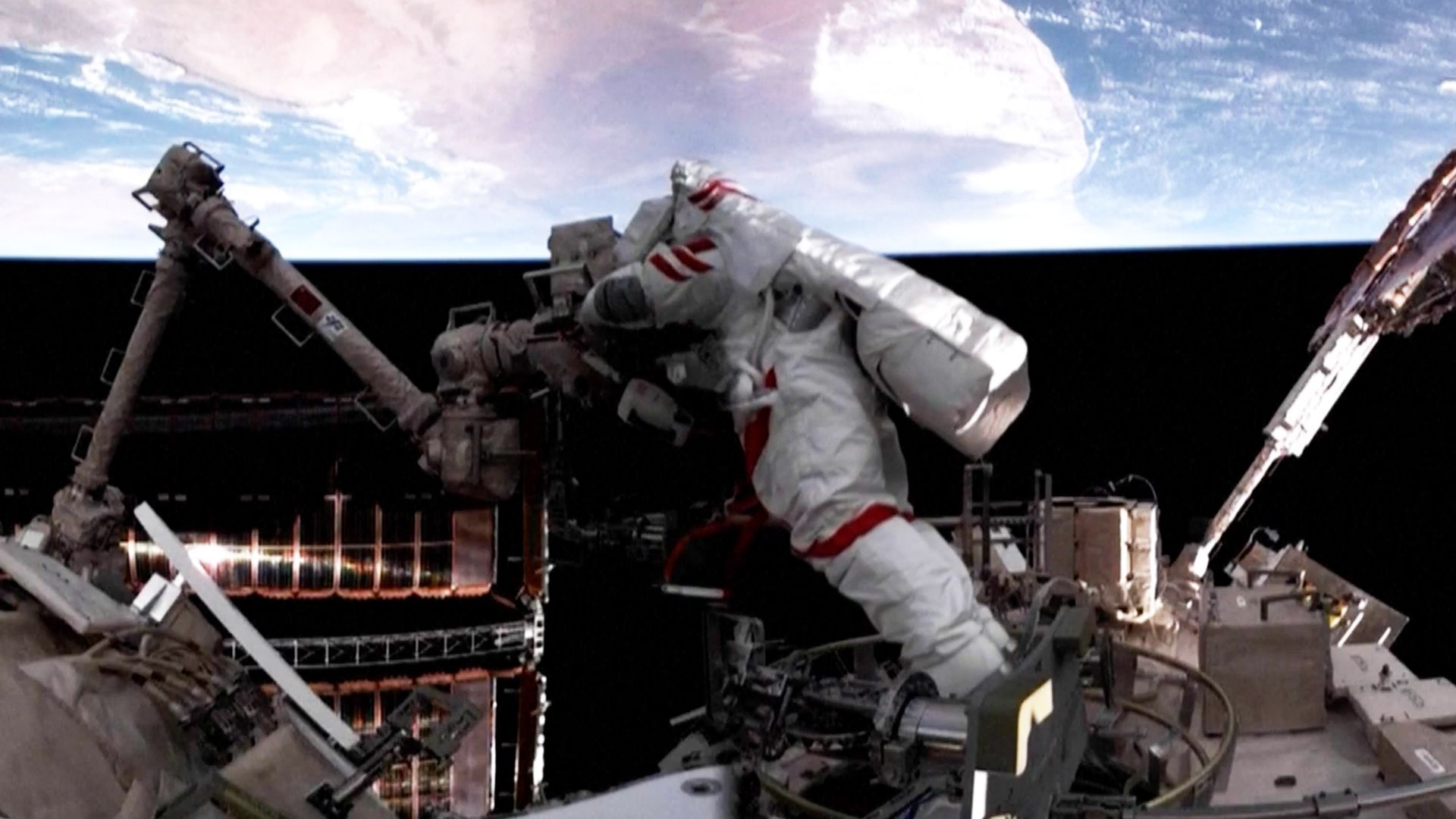
Chinese taikonauts conducted an eight-hour spacewalk on Dec. 9 at the Tiangong station to inspect and photograph damage to the uncrewed Shenzhou 20 return capsule—whose windows were found cracked after an apparent space-junk strike and was declared unsafe for crewed reentry—and to install additional debris protection and replace thermal shielding. Shenzhou 20, which arrived in April, had its crew returned aboard Shenzhou 21 in November and China subsequently launched the uncrewed Shenzhou 22 as a contingency; officials say they plan to recover Shenzhou 20 crewless and Tuesday’s EVA gave them a clearer assessment of its condition. The episode underscores growing operational and schedule risk from orbital debris for China’s human spaceflight program, driving extra on-orbit mitigation work and contingency launches with implications for programme costs, launch cadence and risk/insurance considerations in low-Earth orbit.
On Dec. 9 two members of the Shenzhou 21 crew conducted an eight-hour extravehicular activity at the Tiangong station that inspected and photographed cracks in the Shenzhou 20 return capsule's windows, installed additional space-debris protection and replaced a multi-layer temperature-control cover; the EVA concluded around 5:45 a.m. EST (1045 GMT; 6:45 p.m. Beijing time). Wu Fei became the youngest Chinese astronaut to perform a spacewalk while commander Zhang Lu also exited the station and Zhang Hongzhang supported operations from inside.
Shenzhou 20 arrived at Tiangong in late April and was due to return on Nov. 5, but window cracks discovered in inspections led Chinese officials to declare the capsule unsafe for crewed reentry, prompting the crew to return on Nov. 14 aboard Shenzhou 21; China launched an uncrewed Shenzhou 22 on Nov. 24 as a contingency and plans to recover Shenzhou 20 crewless later. Tuesday's EVA provided a closer, on-orbit assessment of Shenzhou 20’s condition, improving situational awareness for recovery planning.
The incident underscores rising operational and schedule risk from orbital debris for China’s human spaceflight program, creating a need for repeated EVAs, additional shielding and contingency launches that can increase programme costs and affect launch cadence. External signals rate sentiment as mildly negative with a modest market-impact score (0.12), suggesting limited immediate market disruption but meaningful program-level implications for infrastructure, defense and space-technology participants.
AI-powered research, real-time alerts, and portfolio analytics for institutional investors.
Request DemoOverall Sentiment
mildly negative
Sentiment Score
-0.25
