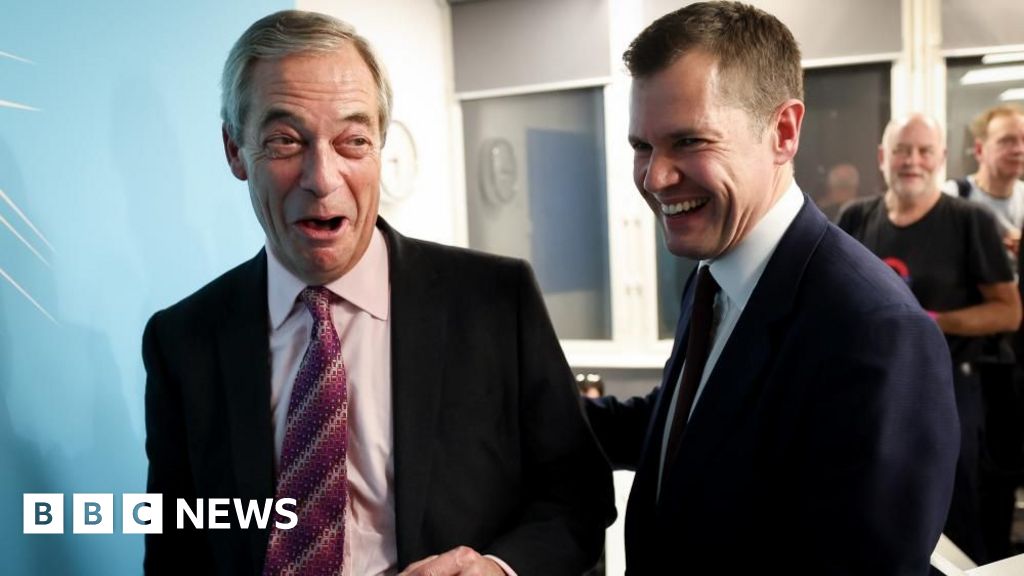
Former Conservative shadow minister Robert Jenrick was sacked by Tory leader Kemi Badenoch after allegedly plotting to defect and immediately joined Nigel Farage's Reform UK at a Westminster press conference, becoming the second sitting Tory MP to switch to Reform amid a recent wave of defections. Jenrick publicly attacked the Conservatives, said he will not force a by-election, and pledged support for Farage; Reform UK already leads national polls and now has six sitting MPs. The move signals further realignment on the British right ahead of the May local and national elections and raises political-risk uncertainty for UK policy outlooks and market-sensitive sectors.
Market structure: Reform UK's accretion of sitting MPs increases political fragmentation risk in the UK, which asymmetrically hurts domestically-focused small/mid caps (housing, retail, regional banks) while benefiting large-cap exporters via weaker sterling and relative safe-haven flows. Expect >5% relative underperformance from FTSE 250 vs FTSE 100 in a meaningful polling shock window (days–weeks) as domestic revenue cyclicals reprice political risk. Competitive dynamics: a sustained Reform surge would shift policy pricing toward immigration/tax policing and potential short-term fiscal posturing, reducing pricing power for consumer discretionary and housebuilders while boosting trade-exposed multi-nationals.
Risk assessment: immediate (0–7 days) tail: GBP volatility ±1–2% intraday and 3–5% swings if defections accelerate; short-term (weeks–months): local elections (7 May) are a catalyst that could amplify seat-level volatility—assign ~20–30% probability of material market move around that date. Long-term (quarters): structural change only if Reform converts polls to seats (<30% probability pre-general election); low-probability/high-impact tails include snap election or coalition that could widen 10y gilt risk premia +50–100bps. Hidden dependencies: seat-conversion mechanics (FPTP) mean national polls overstate parliamentary power; watch local polling and defections count as real triggers.
Trade implications: favor FTSE 100 exporters and defensive staples over UK domestics; implement FX and equity hedges ahead of 7 May. Use targeted, cost-limited option structures for event risk rather than outright directional leverage; size trades to 1–3% NAV per idea and reprice on polling/defection thresholds. Sector rotation: reduce cyclical domestic exposure (housebuilders, regional lenders) and increase consumer staples/large-cap exporters for 3–6 month horizon.
AI-powered research, real-time alerts, and portfolio analytics for institutional investors.
Request DemoOverall Sentiment
moderately negative
Sentiment Score
-0.35
Contrarian angles: consensus assumes Reform will steadily bite into Tory support—markets may overprice this given FPTP seat mechanics; a failure to convert poll leads to rapid mean reversion (GBP +1–2% and FTSE250 +8–12% bounce). If FTSE 250 sells off >15% on politics, selectively add domestic cyclicals at those levels; conversely, cut hedges if Sterling recovers >1.5% or defections stall for two consecutive weeks.
