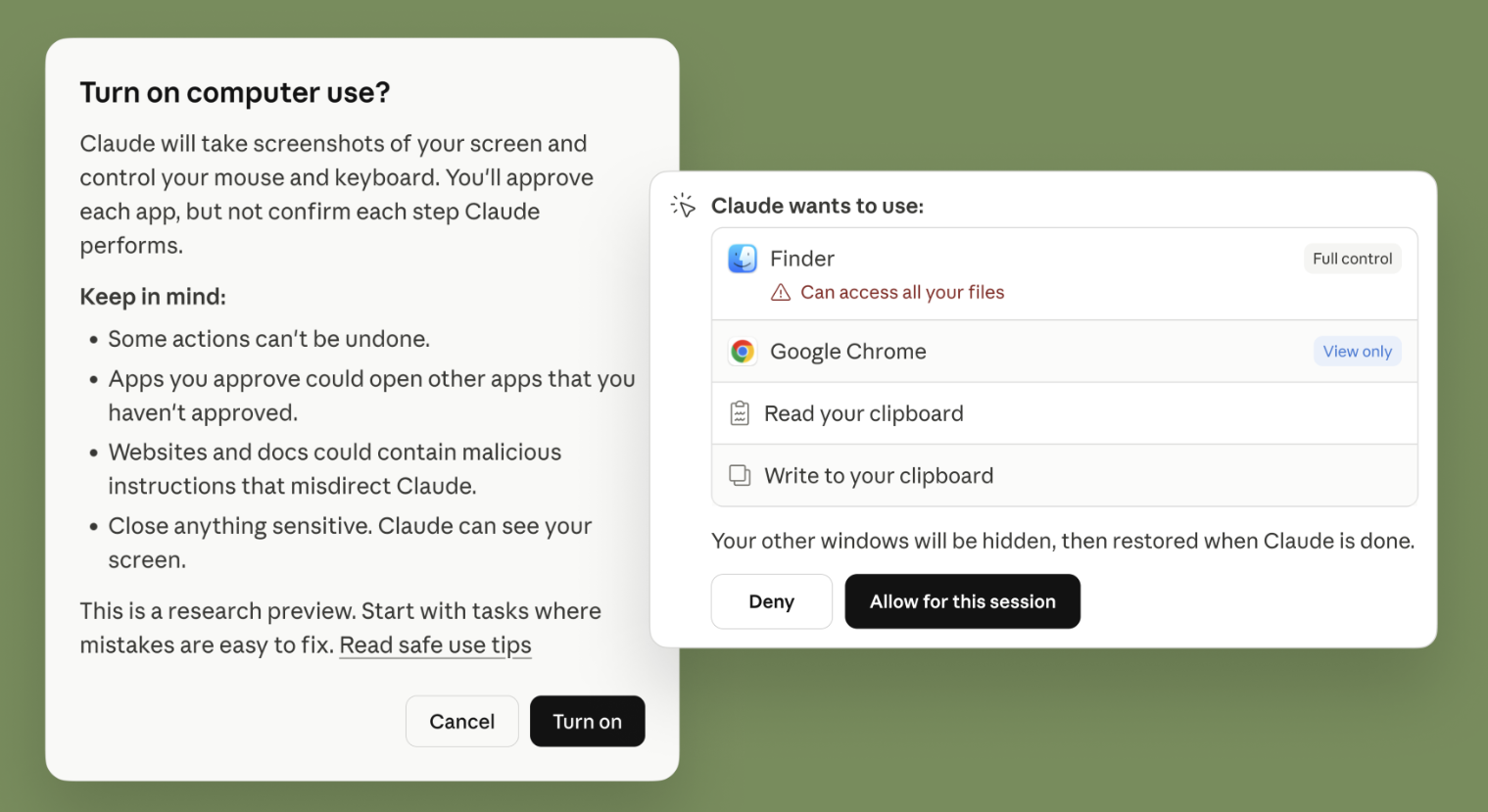
Anthropic launched a research-preview 'computer use' feature for Claude today for Claude Pro and Max subscribers, enabling the assistant to click, scroll and control apps and webpages (Mac-only at launch). The permission-first system uses integrations (e.g., Google Calendar, Slack) or falls back to screen-based control to perform developer tasks like editing in IDEs, submitting pull requests and running tests, but is slower than API integrations and remains error-prone. Anthropic flags security risks — likely linked to third-party 'Claws' such as OpenClaw and prompt-injection — and advises against granting access to sensitive data during the preview while it refines safeguards.
Anthropic’s move accelerates a bifurcation between API-first integrations and fragile screen-based automation. Enterprises will economically rationalize toward vendor-managed connectors that can be audited and patched, creating a near-term revenue path for hyperscalers and SaaS platform owners who can sell “secure AI connectors” as a managed service; expect contract RFP cycles and pilot budgets to shift meaningfully over 6–18 months. Conversely, the screen-control fallback creates a new third-party ecosystem (connectors/agents) that will grow rapidly but carry outsized operational and vulnerability risk.
The biggest non-obvious second-order is procurement and security reallocation: CISOs will redirect discretionary cloud and app budgets into endpoint detection, privileged access management (PAM), and third-party risk tooling. Conservatively, a 5–15% reallocation of automation/IT budgets toward security tooling over 12 months is plausible if enterprises adopt AI agents at scale, which favors vendors that can instrument and attest agent behavior. Regulatory and compliance pushback (auditability, data residency) is a 12–24 month tail-risk that could either entrench enterprise partners or temporarily curtail deployments.
From a product adoption perspective, speed and reliability will decide winners: durable adoption favors platforms that offer native APIs and SSO/SCIM identity integration rather than brittle UI-scraping. That makes cloud infra and identity/security stacks natural beneficiaries, while pure-play RPA vendors face displacement risk unless they rapidly integrate and certify agent-level controls. Given the combination of technical friction, security drag, and regulatory attention, there will be a 3–12 month window where inequalities in trust/attestation translate directly into market share shifts.
AI-powered research, real-time alerts, and portfolio analytics for institutional investors.
Request DemoOverall Sentiment
mixed
Sentiment Score
0.00
