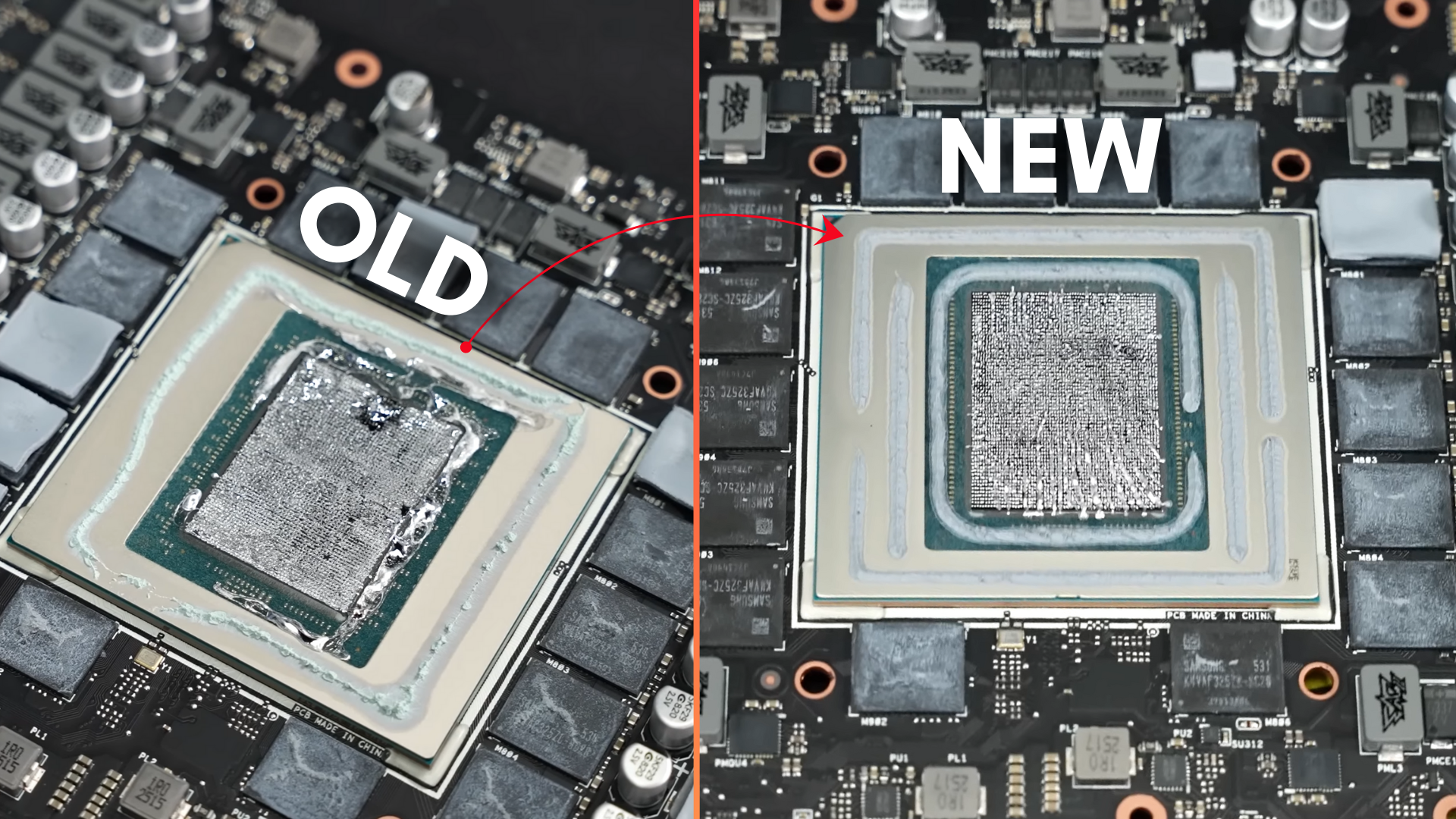
Asus has revised the liquid-metal thermal interface on its $4,000 ROG Matrix RTX 5090 flagship after a recall prompted by uneven factory application; independent teardown by der8auer confirms retail units now feature a perimeter thermal-paste barrier, cutouts for expansion, and a different droplet application process. SEM analysis suggested silicon oil was mixed with the metal to ease mass application; functional testing showed the card drawing nearly 800W in FurMark with lower temperatures, and Asus shipped adapters and tooling to testers. The fix addresses a credible short-circuit risk and represents a deliberate, potentially costly quality-control intervention for a high-ticket product, posing reputational and warranty cost considerations for the company but likely limited broader market impact.
Market structure: This is a micro-level product-quality incident that disproportionately hurts premium AIB/OEM brands (ASUS ROG Matrix) while leaving fabless GPU demand intact — Nvidia (NVDA) and AMD (AMD) retain pricing power for high-end silicon because the issue is TIM application, not GPU performance. Short-term winners include competing board partners with stronger QA reputations (e.g., MSI, potential market-share gains measurable as +1–3% AIB share over the next quarter). Retailers and warranty/service providers could see higher RMA/costs; impact on large-cap PC OEM revenue is likely <1–2% margin hit unless recalls broaden.
Risk assessment: Tail risks include a wider recall network (factory-wide TIM contamination) or a high-profile failure causing a safety/regulatory probe and class-action suits; a broadened recall could cost an OEM several hundred million USD and depress sales for 2–3 quarters. Immediate noise (days) will spike social-media sentiment and IV; short-term (weeks–months) reputational damage is the main risk; long-term (quarters) depends on factory process fixes and supply-chain standardization. Hidden dependency: TIM supply and factory automation consistency — if a single TIM supplier or printing process is flawed, multiple vendors can be hit simultaneously.
Trade implications: Favor exposure to GPU secular winners (NVDA) while avoiding single-OEM execution risk. Construct small, defined-risk bullish exposure to NVDA (1–2% portfolio), use 3–6 month call spreads to limit cost, and implement a relative-value pair: long NVDA vs short DELL (DELL) consumer/gaming exposure (size ~2:1) over 3–6 months. Use options to hedge recall-driven IV spikes in small OEM names and keep stop thresholds (e.g., exit NVDA leg if price drops >8% in 3 trading days).
Contrarian angles: The market may over-penalize GPU ecosystem leaders; historically product recalls (e.g., handset battery recalls) damaged OEM brands but did not alter semiconductor winners’ fundamentals. If ASUS’s fix becomes the new industry standard, aftermarket TIM applicators and cooling suppliers could see >10% incremental TAM expansion over 12–24 months — an overlooked beneficiary. Conversely, if TIM printing fixes reveal a common supplier flaw, be ready to widen short exposure to exposed OEMs quickly.
AI-powered research, real-time alerts, and portfolio analytics for institutional investors.
Request DemoOverall Sentiment
neutral
Sentiment Score
-0.10
Ticker Sentiment
