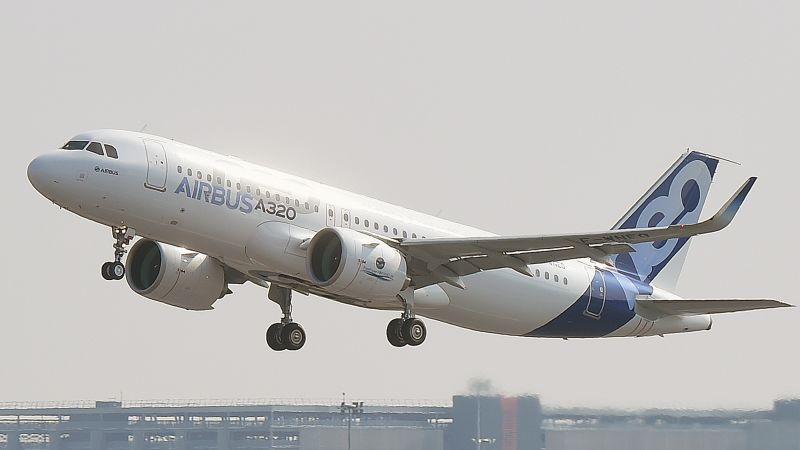
Airbus has issued an alert and EU authorities mandated an airworthiness directive after analysis showed intense solar radiation can corrupt flight‑control data on A320 family aircraft, prompting repairs on roughly 6,000 A319/A320/A321 jets. The action follows an Oct. 30 JetBlue A320 incident that forced an emergency landing and injured passengers; most aircraft can be fixed with a ~two‑hour software update. Major U.S. carriers face varying fleet impacts (American ~340 birds, Delta <50 A321neos, United 6, JetBlue ongoing; Southwest unaffected), causing short‑term operational disruption and potential schedule delays but limited long‑term financial exposure given the quick repair time.
Market structure: The immediate winners are airlines without A320 exposure (LUV) and MRO/software vendors who can bill for ~6,000 quick software patches; losers are carriers with large A320 fleets (AAL: ~340 affected, JetBlue concentrated) and any OEM reputational risk for Airbus. Competitive dynamics: short operational hiccups (2-hour fix per plane) create transient capacity tightness that can shift weekend/holiday market share by a few percentage points to non-affected carriers; pricing power on last‑mile holiday routes may allow higher fares for 3–7 days.
Risk assessment: Tail risks include a wider FAA/EASA grounding (low probability, 5–10%) which could remove 3–5% of global single‑aisle capacity and compress near‑term airline EBITDA by an estimated 1–2% per week of grounding. Time horizons: immediate (0–7 days) — operational disruption and volatility spike; short (weeks) — reputational/cost impacts and MRO backlog; long (quarters) — negligible if fixes stick. Hidden dependencies: MRO labor capacity, software deployment errors, and potential insurance/regulatory follow‑ups could amplify costs.
Trade implications: Tactical alpha window is immediate (enter within 24–72 hours). Expect stock moves of 3–8% intra‑sector; volatility in AAL and JBLU (noted risk) will spike — suitable for short-dated option structures and small directional positions. Cross‑asset: short-dated high‑yield or airline CDS could widen; long USD vs CAD/EUR is possible if Eurozone carriers see more disruption.
Contrarian angles: Market may be overpricing sustained damage — most fixes take ~2 hours and airlines report majority completion in 48–72 hours, so dislocations are short-lived. Conversely, if MRO bottlenecks emerge, aftermarket suppliers could see outsized revenue for 1–2 quarters. Watch FAA/EASA directives and airline completion rates (threshold: >90% patched in 72 hours) as the trigger to reverse trades.
AI-powered research, real-time alerts, and portfolio analytics for institutional investors.
Request DemoOverall Sentiment
mildly negative
Sentiment Score
-0.25
Ticker Sentiment
