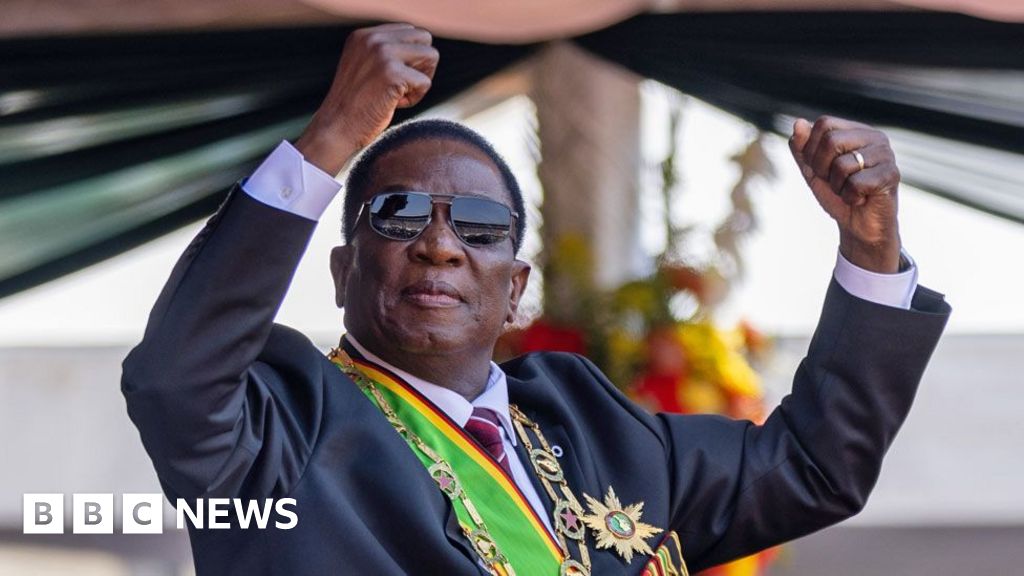
Zimbabwe's cabinet has approved draft legislation that would let President Emmerson Mnangagwa remain in office until at least 2030 by shifting presidential selection from direct popular vote to parliamentary appointment and replacing five-year terms with a maximum of two seven-year terms. Constitutional experts say a referendum is required and that amendments cannot legally benefit a sitting president, making legal challenges likely; the proposal heightens political risk and could undermine investor confidence and sovereign risk perceptions for Zimbabwe and EM exposures.
Market-structure: A formal move to extend Mnangagwa’s rule lifts political tail-risk for entrenched incumbents but raises sovereign and local-asset risk premia. Short-term winners are insiders (state contractors, politically connected mining concessions) and external backers (China) able to underwrite deals; losers are retail holders of local currency, Zimbabwe sovereign and frontier EM ETFs which will likely see spreads widen and liquidity dry up. Cross-asset: expect ZWL depreciation pressure, wider Zimbabwe sovereign CDS (if tradeable), flight-to-safety into USD and gold (GLD/GDX), and potential pressure on regional FX (USD/ZAR) through contagion.
Risk assessment: Tail risks include targeted sanctions, large-scale protests or security crackdowns, and abrupt asset seizures — each could blow out CDS/spreads >500–1,000bp and trigger regional risk aversion. Immediate (days): headline-driven USD/gold spikes; short-term (weeks–months): equity/credit outflows and FX depreciation; long-term (years): possible investor-friendly stability if deals with China/India secure financing. Hidden dependencies: Zimbabwe’s cash flows depend on commodity exports and Chinese state financing; South African contagion risk via trade and remittances is a second-order channel. Key catalysts: parliamentary vote timeline, court rulings overturning amendments, and sanctions announcements.
Trade implications: Tactical risk-off: increase gold and gold-miner exposure (GLD, GDX) and USD longs (UUP or USDZAR spot) over 1–3 months while trimming frontier/EM beta (EEM, AFK). Use options to buy volatility around parliamentary debate windows (30–90 days). Over 6–24 months, selectively re-enter miners with secured offtake/Chinese backing (idiosyncratic due diligence required) if political entrenchment reduces policy uncertainty.
Contrarian angles: The market may overprice permanent expropriation risk; historical parallels (post-coup stabilization in a number of African states) show regime entrenchment can reduce short-term policy reversals and unlock state-led infrastructure deals. If China/India step in with financing within 6–12 months, resource-sector equities could rerate sharply—identify miners with formal contracts and low capex needs. Conversely, mispriced tail risk remains large; avoid binary overweights until legal challenges are resolved and a clear sanctions signal is absent.
AI-powered research, real-time alerts, and portfolio analytics for institutional investors.
Request DemoOverall Sentiment
moderately negative
Sentiment Score
-0.45
