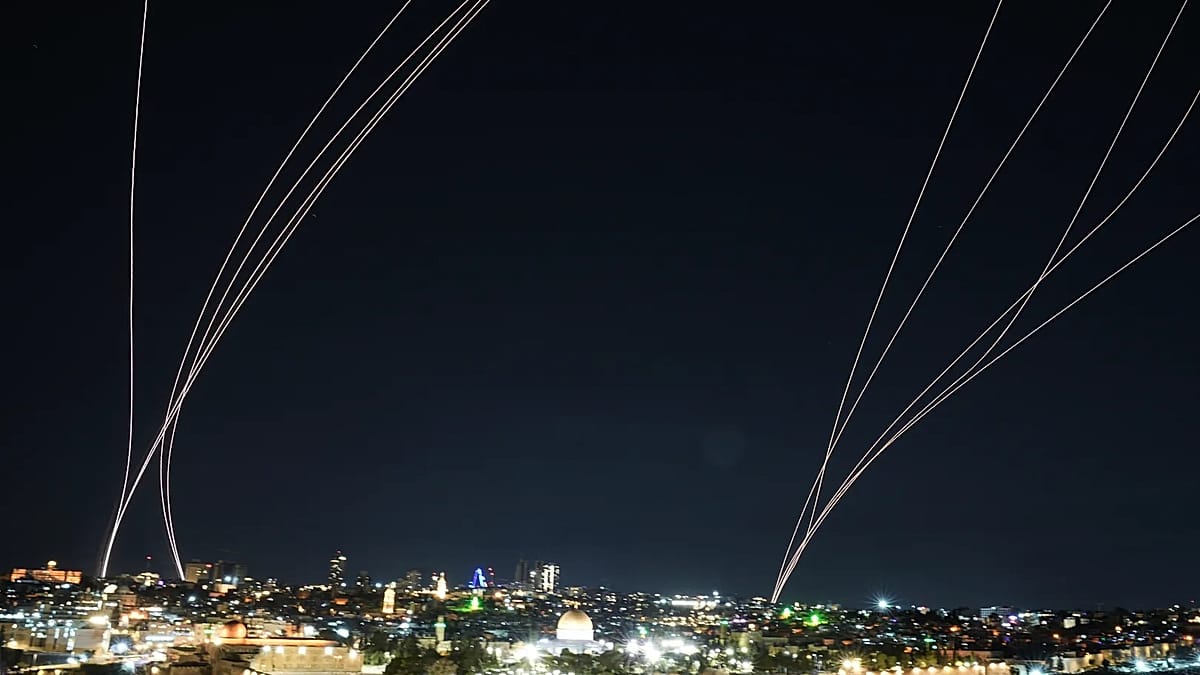
Iran launched the largest recent barrage of ballistic missiles at Israel (around 10 in the central salvo) as overall Iranian strikes have slowed to ~10-15 missiles/day from ~90 on day one. Threats to keep the Strait of Hormuz closed (handling ~20% of global oil) and attacks on Gulf shipping have pushed oil and gasoline prices higher (U.S. gasoline > $4/gal), spiked European inflation and created global economic disruption; markets briefly rallied after a U.S. ceasefire claim that Tehran denied.
Closure of the Strait of Hormuz is manifesting as an immediate logistics shock rather than a pure production cut — expect a sustained freight/insurance premium that adds a rolling cost to delivered crude of roughly $1–4/bbl and adds ~10–14 days to voyages routed around Africa. That incremental cost acts like a per-barrel tax, raising netback breakevens at shore refineries and creating a structural bid for tank storage and VLCC/time-charter markets while simultaneously compressing refinery margins in regions heavily dependent on Gulf feedstocks.
Primary beneficiaries in the near term are flexible US onshore producers and owners of crude and tanker optionality: US shale can ramp sales into a higher price regime within weeks and tankers/time-charters capture the freight spread immediately. Second-order winners include Asian refiners with access to spot cargoes (they arbitrage away some of the premium) and northern European storage operators; losers are Mediterranean/European refiners with limited shipping flexibility, shipping insurers/reinsurers, and integrated refiners that lack quick differential hedges.
Key catalysts and time horizons: market moves within days on headlines (missile salvos, strikes on shipping) but structural re-pricing requires weeks to months — if closure persists >8–12 weeks expect sustained inventory draws, higher SPR releases, and accelerated capex for non-Gulf supply. A rapid diplomatic reopening or credible guarantees on Hormuz reopening would likely produce a sharp mean-reversion of 15–30% in oil forward curves within days; conversely, escalation into direct strikes on export infrastructure would push the premium into a multi-month regime and force inventory-driven price floors.
Consensus is pricing a prolonged chokehold; that can be overstated. The crowd underweights the speed at which US shale and floating storage can arbitrage away acute dislocations and overweights the permanency of route changes — creating asymmetric trade opportunities to buy optionality on both sustained disruption and rapid relief.
AI-powered research, real-time alerts, and portfolio analytics for institutional investors.
Request DemoOverall Sentiment
strongly negative
Sentiment Score
-0.80
