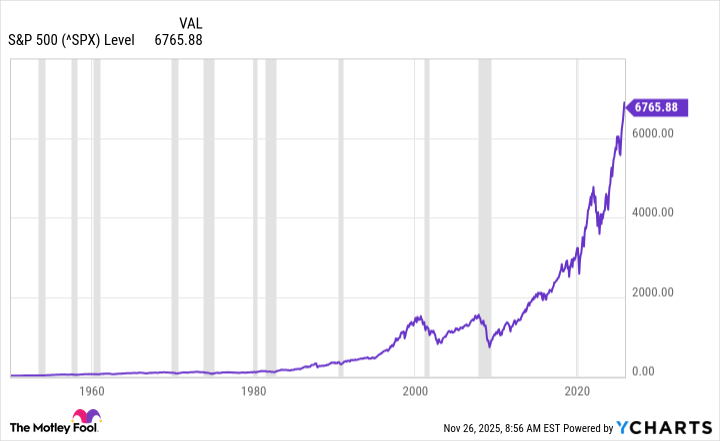
With the S&P 500 trading near all-time highs and worries about a possible 2026 bear market, the piece recommends three Vanguard ETFs for long-term investors: VOO (S&P 500 ETF, expense ratio 0.03%) as a core low-cost equity holding, VIG (Dividend Appreciation ETF, expense ratio 0.05%) which holds stocks with 10+ years of rising dividends while excluding the top 25% highest-yielders and spans ~330 names, and VPU (Utilities ETF, stated expense ratio 0.9%) positioned to benefit from an expected 55% rise in electricity demand 2020–2040 and roughly 90% portfolio exposure to that trend. The note argues buy-and-hold and dollar-cost-averaging through sell-offs rather than market timing, highlighting diversification, dividend-growth orientation, and secular utility demand as durable investment rationales.
Market structure: Near-term winners are large-cap, cash-generative S&P 500 names (tech, consumer staples) and regulated/renewables-facing utilities that will capture the +55% electricity demand tailwind to 2040; losers are cyclical small caps, commodity-exposed industrials, and high-yield dividend names if capital markets tighten. Competitive dynamics favor incumbents with scale in transmission, grid equipment, and data-center power contracts — expect pricing power for copper, transformers, and EPC firms over multi-year capex cycles, tightening lead times and raising project margins for suppliers.
Risk assessment: Short-term (days–months) the dominant risks are a 5–15% equity drawdown and a 50–100bp rise in the 10Y UST that would punish utilities and long-duration growth; long-term (years) risks are regulatory rate caps, grid permitting failures, and supply-chain cost inflation that can erode ROICs. Hidden dependencies include utility earnings tied to state rate cases and renewable PPA pricing; catalysts that can reverse trends are a Fed pivot (lowers yields, benefits utilities/long-duration) or recession (compresses dividends and hits cyclicals).
Trade implications: Tactical allocation should overweight quality/dividend-growth (VIG) and selective utilities exposure (VPU) while keeping core S&P exposure (VOO) with hedges; expect to add on 5–10% S&P pullbacks and trim if S&P falls >20% or 10Y >4.0%. Use options for asymmetric protection (buy 3–6 month SPX 5% put spreads) and prefer pair trades that long dividend-growers versus high-yield laggards to exploit valuation dispersion.
Contrarian angles: Consensus buy-and-hold ETF advice underestimates interest-rate sensitivity and concentration risk in mega-caps; utilities’ long-term capex story is real but crowding could compress future returns if yields reprice higher by >50bp. Historically (2000 vs 2008) quality/dividend strategies outperformed in drawdowns but underperformed in rapid rotations to value — size positions accordingly and avoid full conviction without yield/rate hedges.
AI-powered research, real-time alerts, and portfolio analytics for institutional investors.
Request DemoOverall Sentiment
moderately positive
Sentiment Score
0.35
