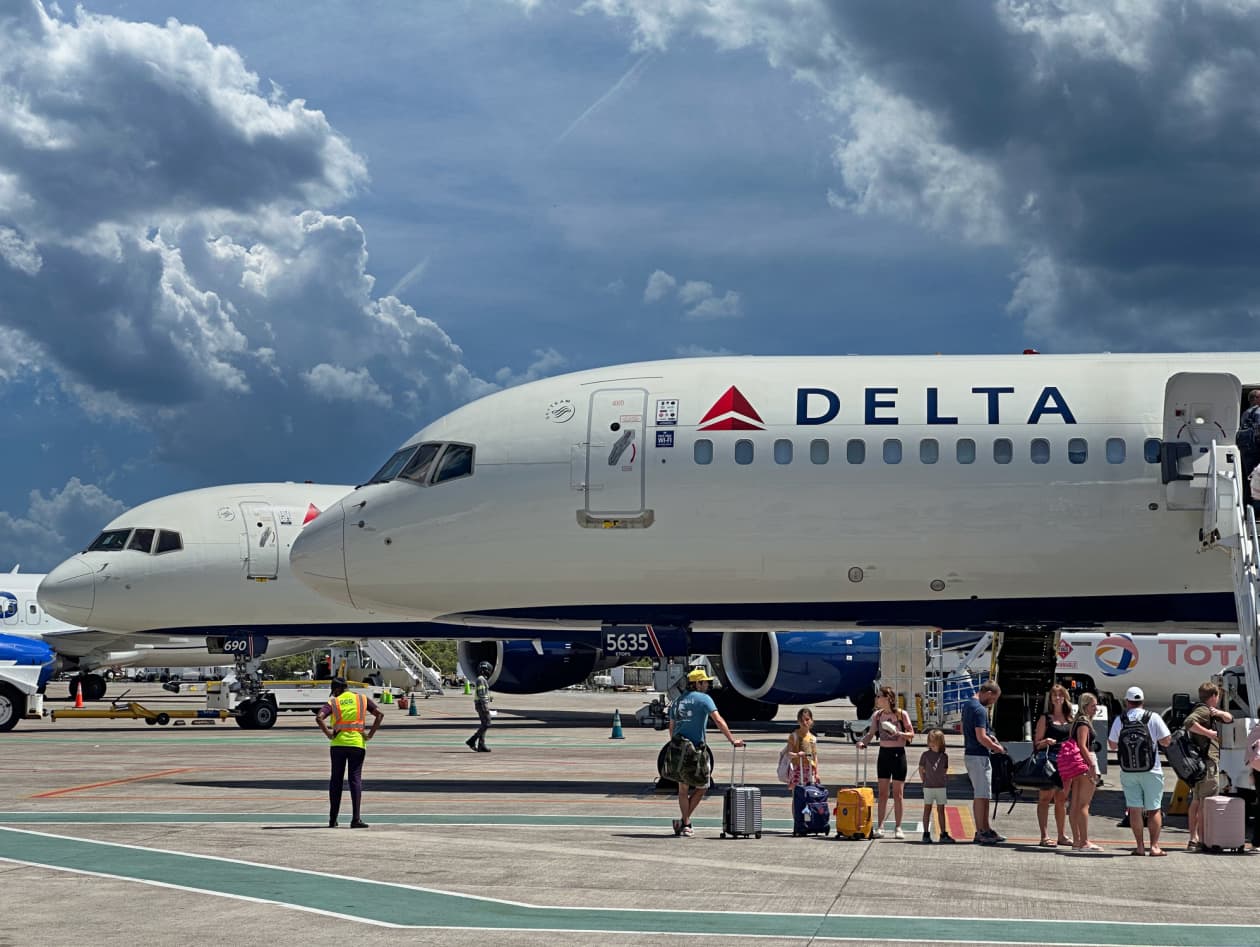
Delta Air Lines said U.S. government shutdown-related cancellations and a temporary pre-Thanksgiving dip in demand will reduce revenue by about $200 million in the holiday (December) quarter, while asserting that December demand 'remains healthy.' The announcement boosted Delta shares and lifted peers American and United, with the airline sector outperforming the S&P 500, signaling short-term relief in market sentiment despite the quarter-level headwind to results and guidance.
Market structure: Delta (DAL) is the direct loser — management cites a ~$200m hit to the December quarter — which compresses near-term margins, raises rebooking/IRROPS costs and risks incremental loyalty friction. Competitors (AAL, UAL) can be short-term beneficiaries if they avoided cancellations and capture displaced passengers; expect 1–3% intra-sector share shifts over the holiday window (days–weeks) rather than permanent market-share moves. Jet fuel exposure and capacity discipline matter: sustained cancellations reduce effective seats and can temporarily tighten fares on unaffected routes.
Risk assessment: Tail risks include a prolonged shutdown (>30 days) or another operational shock that multiplies losses (each extra week could add an order-of-magnitude tens of millions in incremental cost); a material jet-fuel spike (>10% in 30 days) would flip winners to losers. Immediate risks (days) are sentiment and volatility spikes; short-term (weeks) demand pull-forward/loss; long-term (quarters) reputational and corporate-travel recovery. Hidden dependencies: network hub topology, rebooking yield, and corporate contracts (T&E) will determine who actually retains customers.
Trade implications: Tactical pair trade — go short DAL (1–2% notional) vs long AAL or UAL (1–2% notional) for 30–90 days; implement via equal-dollar stock or buy DAL 1-month put spread (e.g., 5–15% OTM) funded by selling nearer-dated calls on AAL/UAL to reduce cost. If volatility jumps, buy calendar or diagonal spreads on DAL to monetize elevated IV around earnings/Q4 updates; consider small long position in JETS (1%) only if fuel declines and shutdown ends within 14 days. Exit or trim positions on catalysts below: DAL underperforms peers by >7% relative in 10 trading days or if company narrows the $200m guidance impact in next update.
Contrarian angles: The market relief rally may be overdone — investors are ignoring hub fragility: Delta’s network complexity means the $200m may understate customer lifetime value loss and higher re-accommodation costs; downside persistence is plausible. Historical parallels (short shutdowns 2013) show quick rebounds, but operational shocks (2001/2010s) produced multi-quarter recovery differences by carrier. If the shutdown ends within 7–10 days and jet fuel falls >5%, current underweights in airlines will look premature; conversely, if cancellations cluster into corporate-heavy routes, long AAL/UAL could disappoint.
AI-powered research, real-time alerts, and portfolio analytics for institutional investors.
Request DemoOverall Sentiment
mixed
Sentiment Score
0.00
Ticker Sentiment
