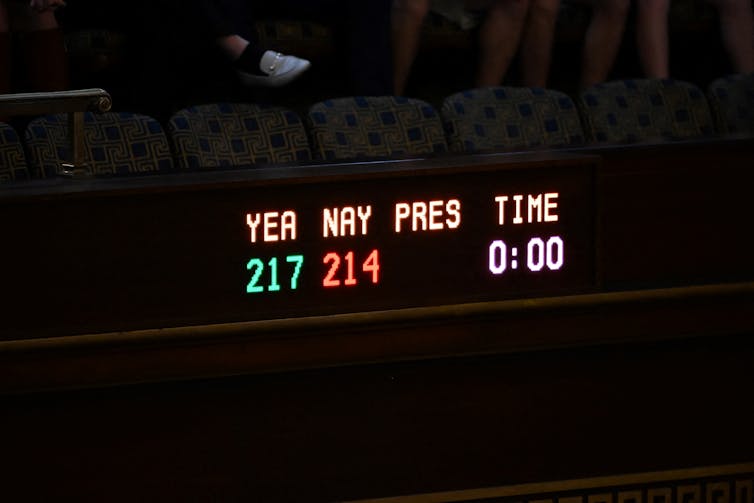
Historical midterm patterns indicate substantial downside risk for the sitting president’s party: since 1946 there have been 20 midterms and in 18 the president’s party lost House seats (90%), and every president with sub-50% approval in the month before a midterm lost seats. Only two exceptions—Clinton in 1998 (+5 seats) and George W. Bush in 2002 (+8 seats)—occurred under unusual circumstances (strong economy and impeachment backlash; post‑9/11 rally). A net shift of five seats would flip the House in 2026, but redistricting, potential changes in presidential approval, and unforeseen events inject meaningful uncertainty into outcomes and attendant policy risk for markets.
Market structure: Historical midterm dynamics favor defensive assets and volatility ahead of Nov 2026; a net swing of +5 House seats flips control and materially raises regulatory/oversight risk for big-tech and banks. Winners: Treasuries (duration), consumer staples (XLP), utilities (XLU), gold (GLD) and election-hedge instruments (VIX/VXX); losers: high-P/E growth (QQQ exposure), small-cap cyclicals (IWM) and regional banks exposed to political/regulatory cycles. Pricing mechanism: higher political risk -> risk premium rises, compressing equity multiples by ~5–15% in contested scenarios over 3–6 months.
Risk assessment: Tail risks include a contested/counted election producing a 5–15% intraday SPX drawdown and VIX spike >40; regulatory shock (unexpected antitrust/tax push) could knock targeted sectors 10–30% over 12–24 months. Timing: immediate (days around key primaries and Oct–Nov 2026) has highest realized vol; short-term (3–6 months) sees sector rotation; long-term (1–2 years) legislative outcomes shift capex/regulatory regimes. Hidden dependencies: redistricting effects, presidential approval crossing 50% (a binary hinge) and macro growth/unemployment moves that can override political signals.
Trade implications: Favor 2–3% duration exposure (TLT or 10y futures) and 1–2% GLD as tail hedges into election season; implement a 2.5% long XLP vs 2.5% short XLY pair from Apr–Dec 2026 to capture a defensives-over-discretionary spread (target relative outperformance 3–6%). Buy a small VIX Nov-2026 20/40 call spread sized ~1% notional as contested-election insurance; trim high-P/E tech (reduce QQQ by 3–5%) now to lock gains.
Contrarian angles: Consensus may overstate a Democratic takeover because redistricting and turnout can mute swings; monitor Gallup/RealClearPolitics presidential approval—if >50% by Sept 2026, unwind defensive duration and VIX hedges. Conversely, an overreactive selloff in small-caps after a disputed count (IWM down >10% vs SPY) is a buy-to-mean-reversion opportunity sized 1–2% with a 6–12 month horizon.
AI-powered research, real-time alerts, and portfolio analytics for institutional investors.
Request DemoOverall Sentiment
moderately negative
Sentiment Score
-0.30
