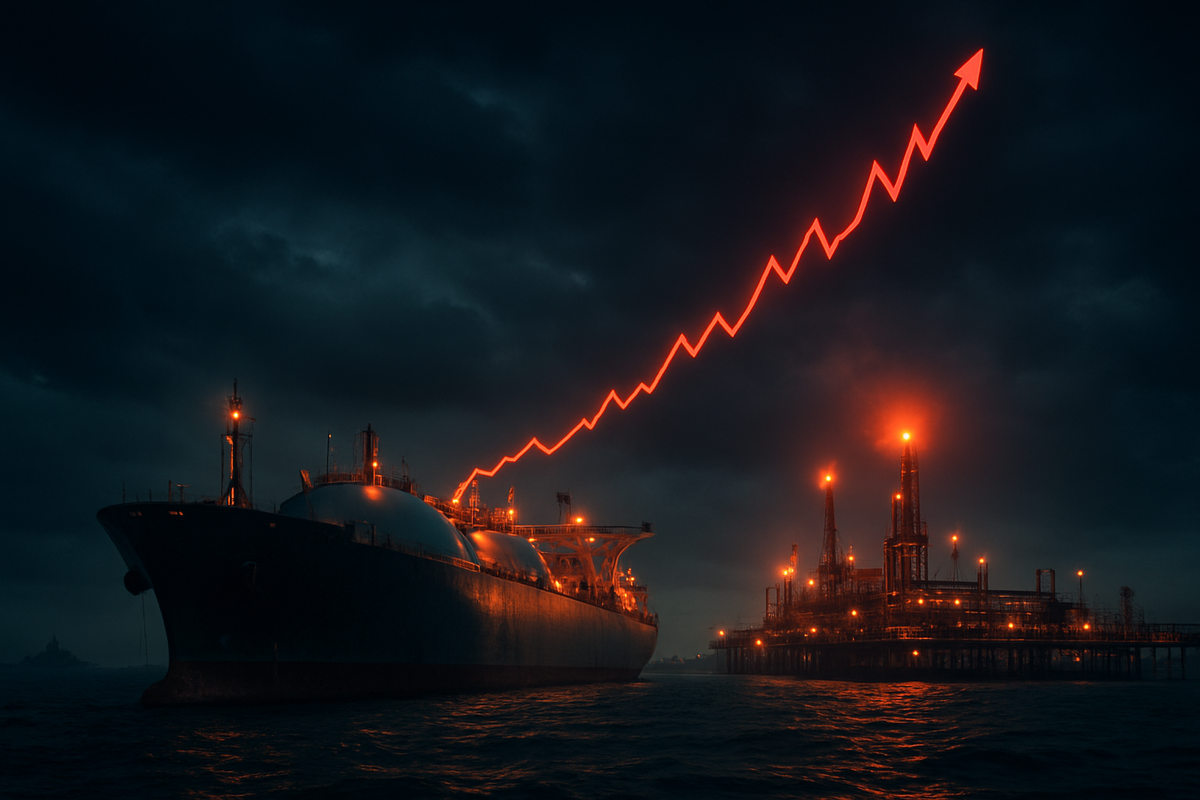
59.4% surge in European natural gas prices in March 2026 drove a 41.6% monthly jump in the World Bank global energy price index, precipitating immediate stagflation risks and mandated industrial curtailments in Europe. The spike was triggered by the 'Siege of Hormuz' (affecting ~20% of global LNG sea transit) and Ras Laffan damage in Qatar that removed ~17% of Qatar’s LNG export capacity, forcing fierce spot-market competition and extreme backwardation. Winners include US LNG exporters (e.g., Cheniere) and Norwegian piped-gas suppliers (e.g., Equinor); losers include European energy‑intensive manufacturers (e.g., BASF) and companies with damaged Middle Eastern exposure, while policymakers accelerate RePowerEU moves, maritime security measures, and a strategic pivot toward Atlantic Basin supplies.
The market has shifted from a price-centric regime to an availability-centric regime where basis and freight drive value more than forward curve convexity. That favors suppliers with spare export capacity and short, controllable logistics chains — structural advantage that persists until spare shipping and liquefaction capacity are demonstrably rebuilt. Expect persistent spot premia to compress integrated-trader netbacks and widen realized margins for FOB producers that can flex cargo volumes within 1–3 months.
Second-order impacts will amplify across capital allocation and trade flows: European heavy industry faces sustained input-cost-driven margin compression that accelerates capex relocation to energy-secure jurisdictions, creating multi-year demand erosion in incumbent industrial clusters. Insurance and freight cost inflation will raise break-evens on marginal LNG cargoes, effectively rationing spot supply to highest-value buyers and advantaging counterparties with credit/sovereign backstops. Energy traders with deep LNG shipping books and US-basin connectivity (and counterparties able to finance long voyages) will capture outsized optionality.
Time horizons and reversal mechanics are clear: market dislocation is driven by physical chokepoints and capital lead times — days-to-weeks for shipping reroutes, months for liquefaction repairs, and years for structural market rebalancing through new FIDs or demand destruction. Key near-term catalysts to watch are actual cargo liftings against forward schedules, insurance rate moves for Gulf transits, and any coordinated Western naval protection plans; a meaningful normalization requires simultaneity on security, repairs, and vessel availability, making a rapid snap-back low probability within 60–90 days but plausible over 6–12 months.
AI-powered research, real-time alerts, and portfolio analytics for institutional investors.
Request DemoOverall Sentiment
strongly negative
Sentiment Score
-0.80
Ticker Sentiment
