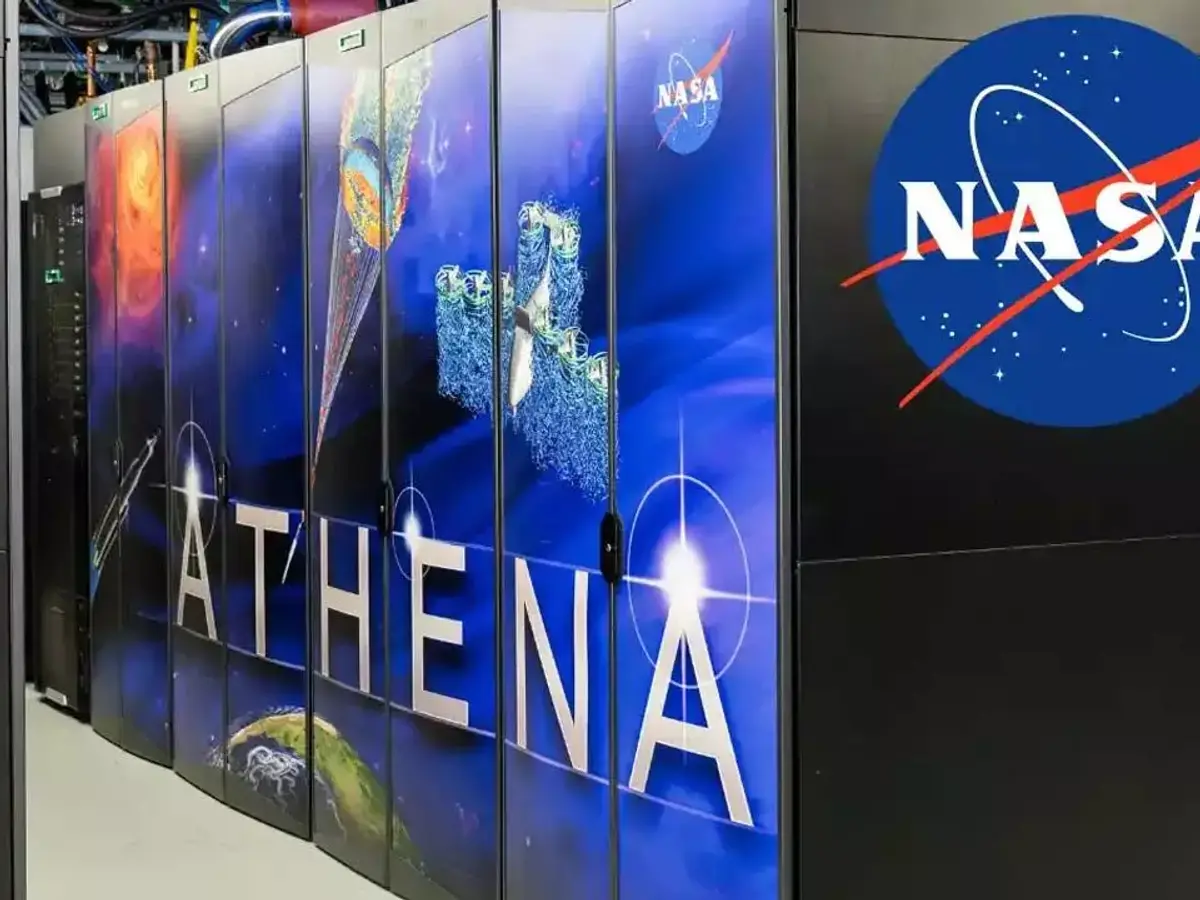
NASA has transferred control of its hybrid supercomputer-cloud capability, 'Athena', to the agency's Chief Science Data Officer, centralizing petabyte-scale data ingestion and analysis under a single governance model. Athena combines traditional HPC with commercial cloud scalability to run high-fidelity planetary simulations that inform spacecraft and launch-vehicle design—claims include reducing mission risk and saving billions by enabling mission engineering in the digital realm. The initiative underscores potential demand for scalable cloud and HPC services in space programs and could accelerate planning for Mars and deep-space missions.
Market structure: NASA’s Athena validates higher, sustained demand for hybrid HPC + cloud stacks — direct beneficiaries are cloud hyperscalers (AMZN, MSFT, GOOGL), GPU/AI chip suppliers (NVDA, AMD) and HPC systems/ops vendors (HPE, LHX, LDOS). Traditional on-prem legacy server vendors and small niche integrators that rely on fixed-hardware procurement face pricing pressure as agencies shift to scalable cloud consumption; expect contract sizes to rise 20–50% in cloud line-items over 1–3 years versus capital hardware spends.
Risk assessment: Tail risks include export controls on AI accelerators, a major cloud outage, or U.S. budget cuts to NASA—each could knock 10–30% off near-term revenue for exposed vendors; regulatory actions around dual-use AI tech are highest-probability in the 6–18 month window. Hidden dependencies: NASA’s choice of multi-cloud vs single-provider allocation will concentratively reallocate revenue — watch procurement notices for 6–12 month signal. Key catalysts: upcoming NASA/DoD RFPs and FY2026 appropriations (next 3–12 months) and hyperscaler earnings that report cloud growth deceleration >200bps.
Trade implications: Direct plays: long NVDA and MSFT/AMZN for cloud/GPU exposure; pair trade long NVDA vs short INTC (expect GPU share gains) with 6–12 month horizon. Options: implement 3–6 month NVDA call spreads (buy 1 ATM, sell 1.2x ATM) to capture upside while capping premium; sell covered calls on legacy hardware names with >5% yield. Rotate portfolio +3–5% into Technology (semis/cloud), +2–3% into Select Industrials (LMT, RTX) and data-center REITs (EQIX) over 4–12 weeks.
Contrarian: The market assumes pure upside for all cloud/AI suppliers; it underestimates procurement concentration — one government multi-year deal could favor MSFT or AMZN disproportionately, leaving others flat. The consensus also understates supply-chain constraints for HBM memory and advanced GPUs; if shortages persist Q2–Q4 2026, NVDA upside may be capped despite demand. Historical parallel: DoD/NASA pushes in the 2000s accelerated a few winners and left many marginal integrators impaired — prefer scale, not small-cap exposure.
AI-powered research, real-time alerts, and portfolio analytics for institutional investors.
Request DemoOverall Sentiment
moderately positive
Sentiment Score
0.62
