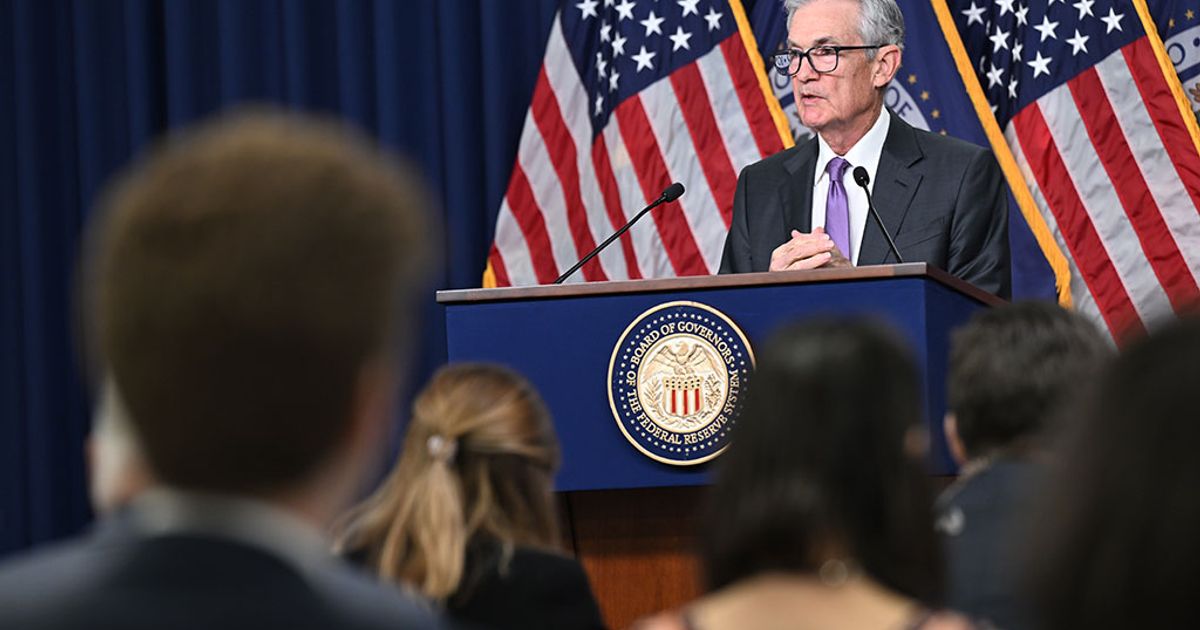
The Federal Reserve held interest rates steady, maintaining the target range at 4.25%-4.5%, while highlighting internal disagreement on future policy. Bank of America anticipates no rate cuts in 2025, citing upward inflation revisions, while Wells Fargo still projects 75 basis points of easing starting in September, though acknowledging increased uncertainty and diverging views among FOMC members. The Fed emphasized data dependency and flexibility amid decelerating growth, persistent inflation, and evolving trade tensions, with market reaction muted as the dollar reversed initial losses following Powell's balanced press conference.
The Federal Reserve maintained its benchmark interest rate target at 4.25%-4.5% during its June policy meeting, emphasizing a strategy of "maximal optionality" as policymakers navigate a complex economic landscape characterized by decelerating growth, persistent inflation, and evolving trade tensions. This cautious stance reflects significant internal division regarding the future path of monetary policy for the remainder of 2025. Institutional interpretations diverge: Bank of America anticipates no rate cuts this year, citing the Fed's upward revisions to inflation, downward revisions to growth, and Chair Powell's apparent lack of concern over recent labor market weakness, alongside emerging tariff-related inflation concerns. Conversely, Wells Fargo maintains its forecast for 75 basis points of easing by year-end, starting with a September cut, driven by an increasing focus on downside growth risks, even as they acknowledge a growing dispersion in FOMC member views, with seven members now projecting no cuts in 2025, up from four in March. While the median Summary of Economic Projections (SEP) continues to indicate two rate cuts by year-end, Chair Powell's admission that "no one holds these rate paths with a great deal of conviction" underscores the prevailing uncertainty, a sentiment echoed in the FOMC's description of the economic outlook uncertainty as "diminished" yet still "elevated." The market reaction was measured, with the US dollar initially declining on the SEP's dovish implications before recovering during Powell's more balanced press conference. The Fed's data-dependent approach means upcoming economic data, particularly on inflation and growth, along with developments on the trade front, will be critical in shaping future policy decisions.
AI-powered research, real-time alerts, and portfolio analytics for institutional investors.
Request DemoOverall Sentiment
mixed
Sentiment Score
0.00
Ticker Sentiment
