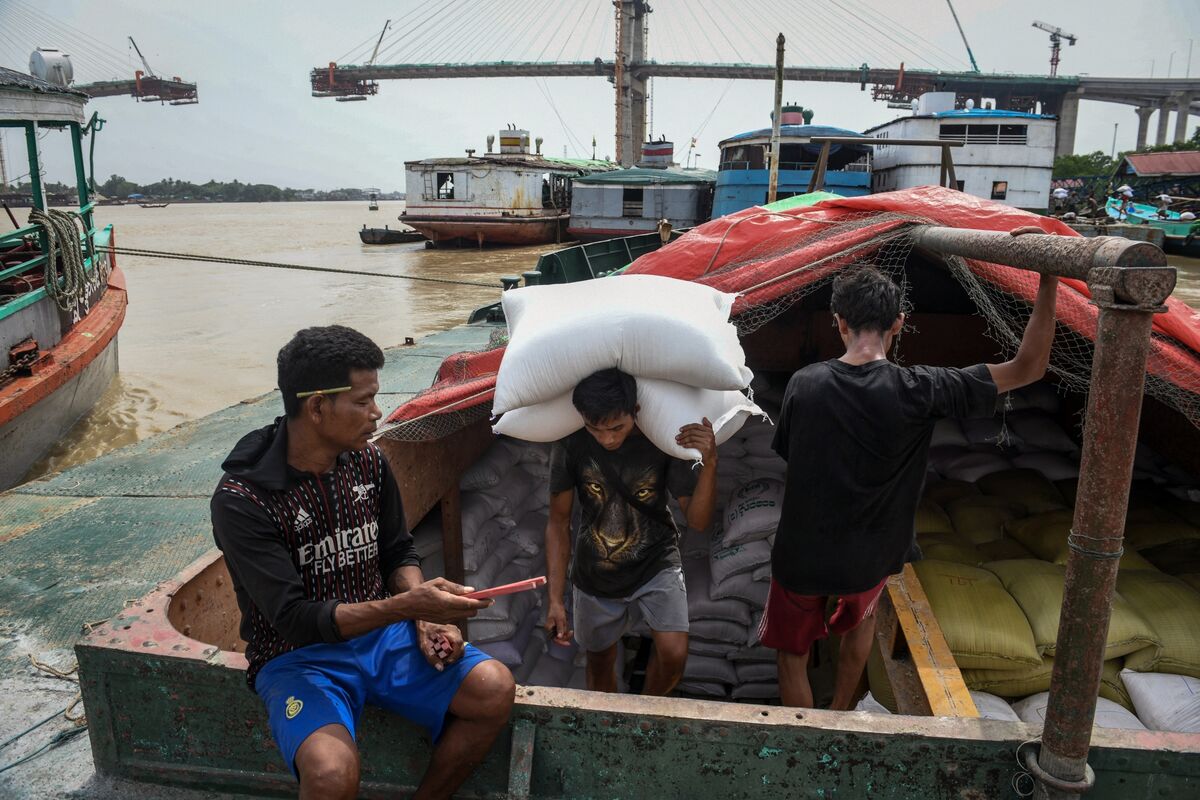
The World Bank projects Myanmar’s GDP will contract 2% in the year ending March (versus its prior -2.5% estimate), citing the civil war, the March earthquake, weak domestic demand, labor shortages and frequent power outages as key drags. The outlook sharply contrasts with the military government’s 3% growth forecast and heightens sovereign and emerging-market risk for investors with exposure to Myanmar’s economy and infrastructure-dependent sectors.
Market structure: The World Bank downgrade signals immediate demand collapse in Myanmar (GDP -2% y/y) hitting domestic banks, telecoms, retail and construction; exporters with local supply chains (garments, agriculture) see lower output and pricing power. Winners in a risk-off move are regional safe-havens and liquid hedges — USD, JPY, gold (GLD/GDX) — and sovereign-credit protection as Myanmar sovereign spreads and frontier-EM FX (MMK) should weaken 5-20% in stressed scenarios.
Risk assessment: Tail risks include a major military escalation or broad sanctions that cut Chinese gas/energy flows (low-probability, high-impact) and refugee flows into Thailand/Bangladesh causing regional fiscal burdens; these could materialize within weeks-to-months. Hidden dependencies: Chinese pipelines and commodity transit routes create contagion channels to ASEAN trade; catalysts to watch are new sanctions (30–60 days) or sizable aftershocks that reduce output by another 5–15%.
Trade implications: Tactically reduce frontier exposure and buy protection: expect EM sovereign spreads to widen 25–100bp; implement short/put exposure to frontier ETFs (FM) and buy 3-month puts on EMB (or a 2:1 put spread) sized to 0.5–1.5% of AUM. Rotate into gold (GLD 1–2%), Singapore equities (EWS) and defense names (LMT, RTX) as relative safe havens over 1–3 months.
Contrarian angles: Consensus underestimates reconstruction upside — if conflict stabilizes in 6–12 months, Chinese construction and materials firms could gain sizable contracts; selective long ideas (small exploratory positions) in global heavy-equipment (CAT) or regional materials exporters could pay off, but only after measurable political stabilization (e.g., ceasefire >90 days).
AI-powered research, real-time alerts, and portfolio analytics for institutional investors.
Overall Sentiment
moderately negative
Sentiment Score
-0.60
