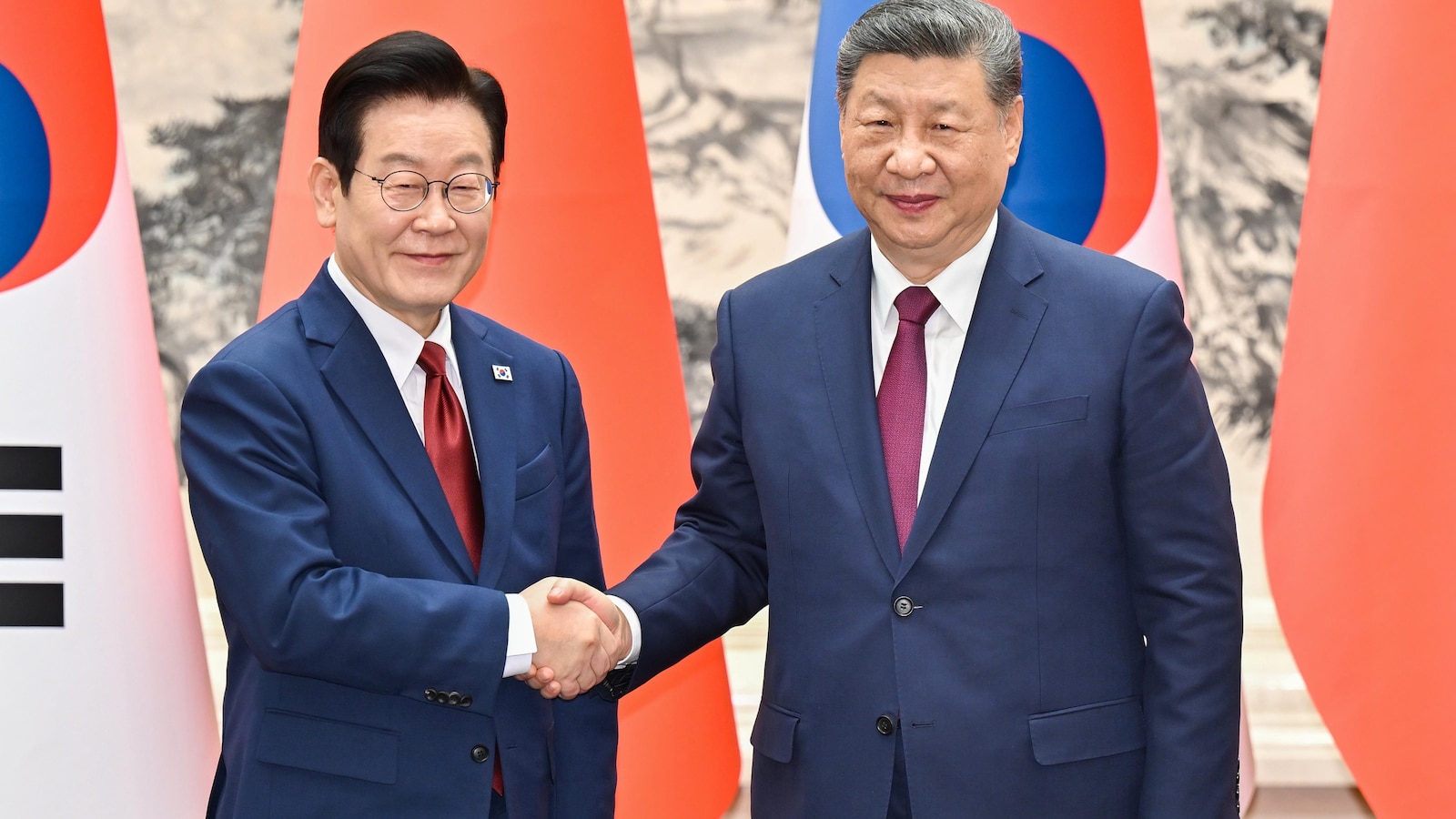
South Korean President Lee Jae Myung asked Chinese President Xi Jinping to act as a mediator to revive diplomacy and address North Korea's nuclear program, with Chinese leaders urging patience. Lee promoted a phased denuclearization-for-benefits approach and said China broadly shared the view, but Pyongyang has rejected denuclearization, continuing weapons development and leaving regional stability and sanctions dynamics unresolved—an outcome that preserves geopolitical risk for investors focused on Northeast Asia and defense-related exposures.
Market structure: A credible Chinese mediation path reduces immediate military-risk premia and benefits South Korean cyclicals, tourism, insurers and exporters while removing some upside for defense contractors (LMT/NOC/RTX). Expect near-term compression in FX volatility (KRW stronger by ~2-4% on successful signals within 1–3 months), downward pressure on gold and safe-haven bonds, and a fall in option-implied vols across Asia equities by 10–30% on positive headlines.
Risk assessment: Tail risks remain material — a miscalculated provocation or failed diplomacy could spike regional volatility (VIX-equivalent +30–80%, KRW -5–10%) with 5–15% annualized probability. Immediate (days) moves will be headline-driven; short-term (weeks–months) depends on China’s concrete incentives (sanctions/leverage) and upcoming joint US-ROK exercises; long-term (quarters–years) regimes could lock in higher defense budgets and supply-chain relocation, benefiting defense & infrastructure suppliers.
Trade implications: Tactical plays should be asymmetric: small, patient long exposure to Korea risk-on and FX appreciation vs low-cost geopolitical insurance via defense exposure and volatility hedges. Use 3–12 month expiries: buy Korea equity exposure (EWY) sized 2–3% NAV with capped downside protection, and hold 1–2% NAV in defense call spreads as tail insurance; keep 0.5–1% in gold/TLT as dynamic hedges triggered by 3–5% daily moves.
Contrarian angles: The market underprices China’s incentive to stabilize the peninsula (refugee risk, US base costs) — probability of incremental back-channel engagement is higher than consensus. If mediation gains traction, defense contractors could sell off 10–25% quickly; consider pair trades (long Korea exporters, short US defense) and set mechanical unwind triggers (e.g., 60 days without missile tests or EWY +8%).
AI-powered research, real-time alerts, and portfolio analytics for institutional investors.
Request DemoOverall Sentiment
moderately negative
Sentiment Score
-0.30
