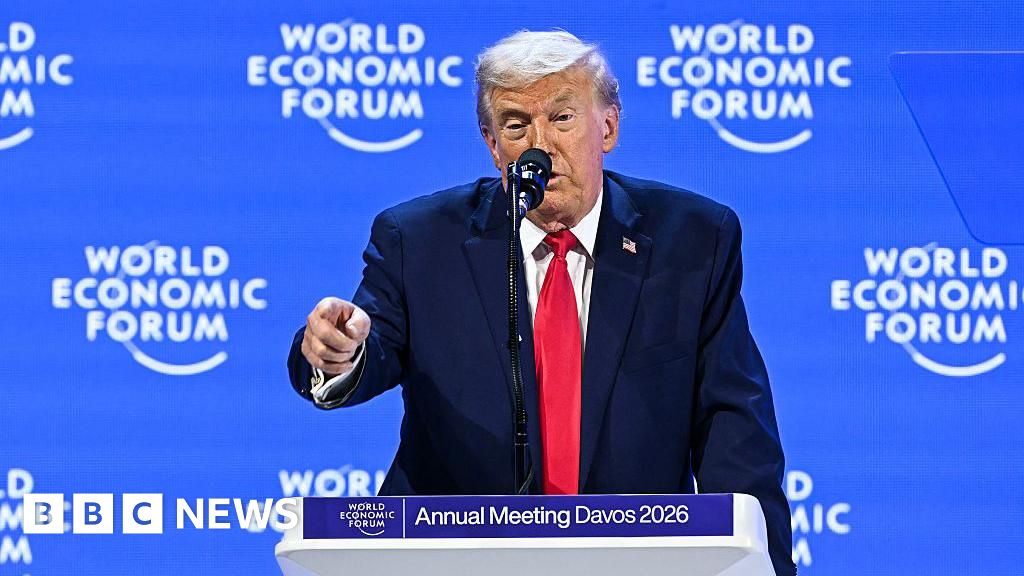
At Davos President Trump delivered a controversial speech proposing immediate negotiations for the United States to acquire Greenland, asserting a need for “full title” and framing the territory as strategic for American defense, while also criticizing European allies. The remarks prompted mixed reactions from world leaders and business figures, with a key Republican senator saying Congress would not back such an annexation, creating political uncertainty that could influence geopolitical risk pricing and investor sentiment in defense and regional exposure.
Market structure: Political theater around Arctic sovereignty lifts defense and Arctic-capex optionality while pressuring European political-risk-sensitive assets. Expect US defense primes (LMT/RTX/NOC) to show 5–10% relative outperformance vs. S&P over 3–6 months on incremental premium for perceived geopolitical risk; gold and long-dated Treasuries should see 1–3% moves immediately as safe-haven flows while oil/Arctic E&P upside is longer-term and idiosyncratic.
Risk assessment: Tail risks are low-probability but high-impact—diplomatic escalations, targeted tariffs, or Congress-driven budget fights—that could spike volatility 30–80% intraday and widen credit spreads by 25–75bp. Immediate (days): bid for safe havens and volatility; short-term (weeks–months): re-rating of defense and FX; long-term (quarters+): potential shifts in capital allocation to Arctic infrastructure if policy momentum develops. Hidden dependency: Congressional opposition (Tillis) and allied backlash are likely brakes; watch NATO/EU statements as gating catalysts.
Trade implications: Tactical trades favor small, conviction-weighted longs in defense and insurance via equity or defined-risk options, a 1–2% tactical long in gold as portfolio insurance, and a 1–2% USD overweight versus EUR/CAD for 1–3 months. Use short-dated call spreads on VIX products (30–60 day) sized 0.5–1% to hedge event risk; avoid large directional bets on Arctic energy until policy signals clear.
Contrarian angle: Consensus treats this as mere rhetoric—too complacent. If defense multiples widen without fundamental orders, mean reversion risk is real; prefer buy-on-dip approach (add on >5% pullback) and cap exposure to 3% per name. Historical parallel: 2016–18 rhetoric-driven defense rallies peaked then reversed when budgets slowed—manage position sizing and legislative catalysts accordingly.
AI-powered research, real-time alerts, and portfolio analytics for institutional investors.
Request DemoOverall Sentiment
moderately negative
Sentiment Score
-0.35
