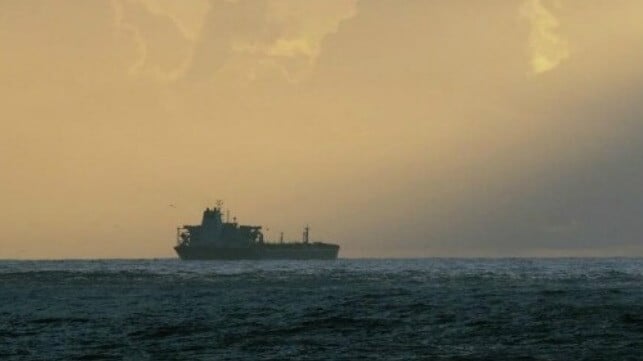
A U.S. destroyer, USS Stockdale, has repeatedly positioned itself to block the sanctioned tanker Seahorse from approaching Venezuela—forcing the 70,246-dwt vessel to turn back three times and leaving it north of Aruba alongside other tankers 'awaiting orders'—after tracking data showed attempts to deliver naphtha from Russian refineries to Venezuela. The Seahorse, built in 2004, has been sanctioned by the EU (May 2025) and UK (July 2025), displays a likely false Comoros flag, and failed an October 2024 inspection citing a dozen deficiencies. U.S. interdiction is being framed as part of a broader 'maximum pressure' campaign by the Trump administration that includes a Caribbean naval build-up, consideration of military strikes against Venezuela, and parallel sanctions on Iran and Russia (Rosneft and Lukoil measures effective Nov. 21), actions analysts say are already disrupting Russian crude flows to India and China and could strand roughly 48 million barrels at sea.
Bloomberg-tracked naval interdictions show the U.S. destroyer USS Stockdale has physically blocked the sanctioned tanker Seahorse from approaching Venezuela on three reported occasions, beginning with an initial approach on November 13 that resulted in a U-turn toward Cuba. AIS data places the 70,246-dwt Seahorse—built 2004, eight previous names, flagged falsely as Comoros per Equasis and sanctioned by the EU (May 2025) and UK (July 2025)—north of Aruba along with several tankers “awaiting orders.” Its last inspection (Oct 2024) in the Russian Black Sea cited roughly a dozen operational and safety deficiencies.
The interdiction is presented as part of a broader “maximum pressure” U.S. campaign against Venezuela and parallel sanctions on Iran and Russia; U.S. sanctions on Rosneft and Lukoil formally begin Nov. 21. Analysts using Kpler data report about 50 tankers still en route to China and India and speculate that nearly 48 million barrels of Russian crude could be effectively stranded, indicating material near-term disruption to seaborne flows.
Market implications include elevated geopolitical risk premia for crude and refined products—particularly naphtha/diluent flows used to sustain Venezuelan operations—heightened shipping and insurance counterparty risk, and greater volatility if interdictions or military escalation accelerate enforcement activity.
AI-powered research, real-time alerts, and portfolio analytics for institutional investors.
Request DemoOverall Sentiment
moderately negative
Sentiment Score
-0.55
