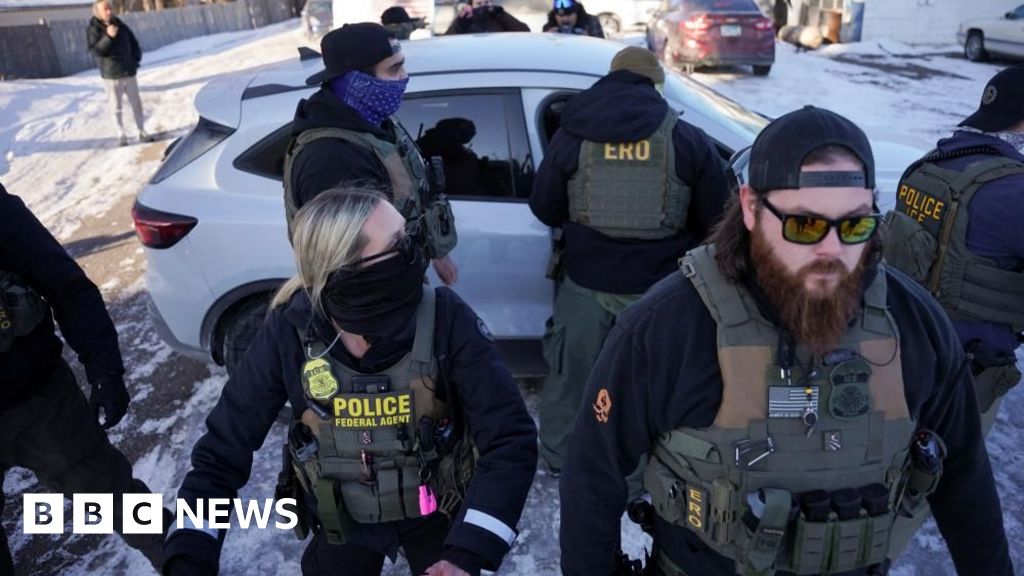
The administration began withdrawing roughly 700 federal immigration agents—about a quarter of the force—from the Minneapolis area, leaving approximately 2,000 agents and aiming to return to pre-December surge levels. Operation Metro Surge produced arrests reportedly including 14 charged with homicide, 139 with assault, 87 sex offenders and 28 gang members, but provoked protests after two residents were fatally shot and a five-year-old was briefly detained; DHS plans to prioritize issuing body-worn cameras. Separately, a Justice Department lawyer was removed after critical courtroom remarks and reports cite tensions between President Trump and adviser Stephen Miller, highlighting heightened political and legal risk around federal immigration enforcement with limited direct market implications.
Market structure: Direct beneficiaries are vendors of body-worn cameras and secure communications as DHS prioritizes deployment — notably Axon Enterprise (AXON) and Motorola Solutions (MSI) — with potential incremental revenue of low-to-mid hundreds of millions nationally over 12–24 months. Losers include private corrections/detention operators (GEO, CXW) and local Minneapolis service industries if enforcement-related unrest and litigation drive reduced foot traffic or higher insurance/settlement costs; expect municipal budget pressure and legal spend to rise by low-single-digit % of city budgets over 1–2 years in stressed scenarios.
Risk assessment: Tail risks include a major civil disturbance or large class-action settlements that widen Minneapolis muni spreads by >25–50bps and force state-level policy reversals; electoral shifts (6–12 months) could rapidly re-tighten or loosen enforcement nationwide, changing demand for both tech and detention services. Immediate window (days–weeks) is reputational and headline-driven volatility; short-term (1–3 months) centers on contract announcements and budget reallocations; long-term (6–24 months) is structural adoption of body-cam/cloud models and municipal legal liability trends.
Trade implications: Tactical long in AXON (AXON) and MSI (MSI) as 1–3% portfolio positions with 3–9 month horizons to capture procurement waves; hedge with 3–6 month call-buyers sizing ~0.5% notional. Short GEO Group (GEO) and CoreCivic (CXW) via 3–6 month put spreads sized 0.5–1% to reflect contract volatility and litigation tail risk; pair trade: long AXON, short GEO to isolate enforcement-vs-tech exposure.
Contrarian angles: The market underestimates recurrent procurement after high-profile incidents — 2014 Ferguson catalyzed ~$200–400m in federal/local camera spend over 24 months; if DHS funding is real, AXON/MSI upside is underpriced and corrections operators are overvalued given political and legal volatility. Watch for triggers: DOJ/DHS contract notices in next 30–60 days and Minneapolis muni spread moves >25bps as signal to reweight positions.
AI-powered research, real-time alerts, and portfolio analytics for institutional investors.
Request DemoOverall Sentiment
moderately negative
Sentiment Score
-0.35
