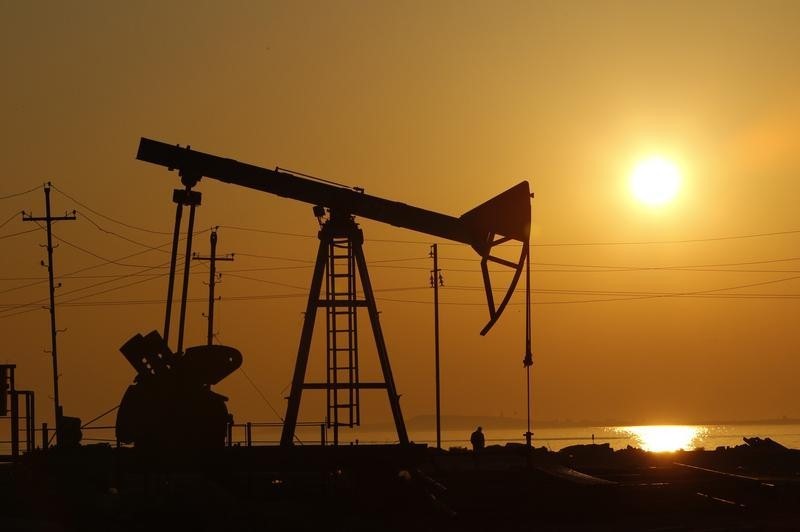
Brent crude rose 1.2% to $110.63 a barrel and U.S. crude gained 1.0% to $106.42 as Gulf drone attacks and the Strait of Hormuz closure kept energy and inflation risks elevated. U.S. 10-year yields climbed to 4.584% after a 23 bps weekly jump, while markets price a 50-50 chance of a Fed hike this year ahead of Wednesday’s minutes. Asia equities fell, with Japan’s Nikkei down 0.4%, South Korea off 2.1%, and MSCI Asia-Pacific ex-Japan down 0.6%, as investors await Nvidia earnings and key China data.
The market is starting to price a regime shift from a geopolitical shock into a macro shock: the first-order winner is energy, but the more important second-order loser is duration-sensitive growth. If oil stays elevated for multiple weeks, the bigger transmission is not just higher CPI prints — it is a forced repricing of real yields and terminal policy rates, which compresses equity multiples even if earnings hold up. That makes the recent move in semis and broad tech vulnerable to a double hit: valuation compression plus the possibility that capex enthusiasm gets questioned if customers have to defend margins against energy inflation.
The most interesting relative trade is that the U.S. becomes a cleaner macro beneficiary than Europe or Japan because it exports energy and imports less inflation from the spike. That should support the dollar and pressure multinational earnings via translation and tighter global financial conditions, especially in markets already dependent on foreign capital. For credit, the risk is that this becomes less about default risk and more about spread widening through higher discount rates and lower liquidity; financials with large bond books and rate-sensitive asset bases are exposed even if their direct oil exposure is small.
The AI complex faces an asymmetry: the narrative can survive a good Nvidia print, but the multiple may not if management commentary implies any moderation in hyperscaler spend or if the guide acknowledges supply-chain inflation. The consensus is still treating AI as a standalone secular theme, but in a sustained oil shock it behaves more like a high-duration levered growth basket whose cash flows are discounted harder. Conversely, retailers like Walmart may be a relative safe haven only if they can pass through fuel-driven logistics costs without volume loss; otherwise the market will start haircutting consumer demand elasticity assumptions into the holiday season.
The contrarian view is that the bond selloff may already be doing some of the Fed’s work, reducing the odds of a hike by tightening financial conditions faster than policymakers would want. If crude fails to hold near current levels or shipping flows normalize even partially, the inflation scare could unwind quickly because positioning is extremely crowded on the risk-off side. In that case, the best reversal trade is likely not an outright beta long, but a rotation out of defensive duration and into quality cyclicals with pricing power.
AI-powered research, real-time alerts, and portfolio analytics for institutional investors.
Request DemoOverall Sentiment
moderately negative
Sentiment Score
-0.35
Ticker Sentiment
