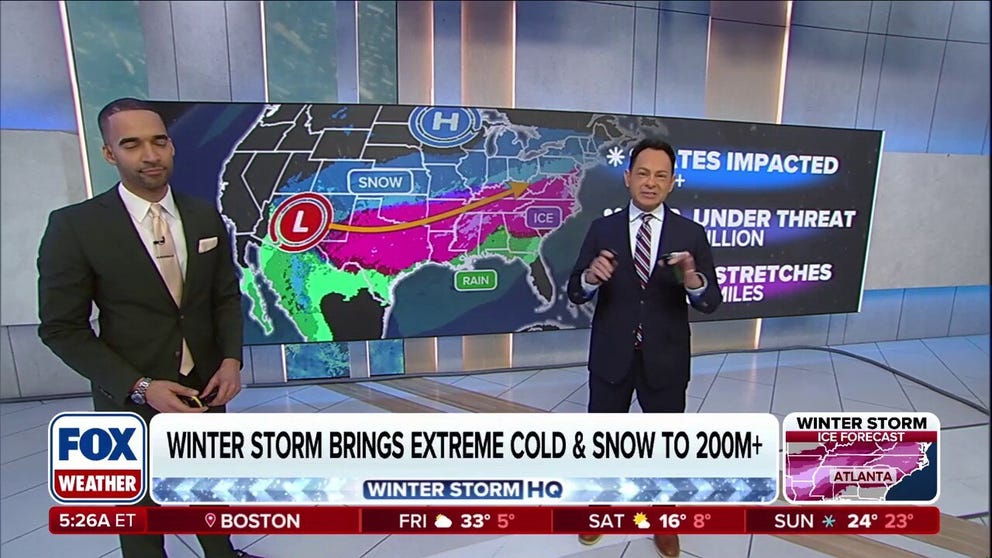
A sprawling winter storm will put more than 200 million people across 35+ states in the path of dangerous snow and crippling ice across a 2,000-mile swath beginning Friday, prompting states of emergency in Texas, North Carolina and South Carolina. Forecasters highlight a bull's-eye of ice from East Texas through southern Arkansas and a more-than-foot snow threat for parts of the Mid‑Atlantic and New York tri‑state area, with widespread flight cancellations and the potential for long-duration power outages that could impede restorations. Monitor exposure in regional utilities, energy demand (heating/natural gas), airlines, insurers and logistics providers for near-term operational disruption and pricing/claims volatility.
Market structure: Short-duration winners are natural-gas producers, peaker power generators and backup-power equipment makers (spot power and fuel sales spike; expect localized power prices +30–200% intraday in ISOs) while airlines, airports, surface logistics and regional retailers take immediate revenue hits from cancellations and store closures. Regulated utilities face near-term outage-related costs but high chances to recover through rate cases—small municipal utilities and non-investment-grade municipal issuers are more vulnerable. Cross-asset: expect safe-haven bid into Treasuries (yields down), USD strength intraday, higher implied vol for travel/transport equities and directional upside in NG/heating-fuel and diesel markets.
Risk assessment: Tail risks include multi-day widespread outages causing industrial stoppages (>$5bn GDP exposure in corridor) or refinery/power-plant mechanical failures that elevate fuel spreads; insurance/reinsurance reserve hits and credit stress for regional banks are low-probability but material. Time horizons: immediate (0–7 days) travel/logistics disruption; short-term (1–8 weeks) energy-price and utility-stock repricing; medium-term (1–6 months) potential regulatory/rate-case recovery for utilities. Hidden dependencies: restoration constrained by refreeze cycles, crew staging, fuel/diesel logistics and municipal coordination; storm- track shift offshore is catalyst for larger Northeast snowfall and prolonged disruption.
Trade implications: Tactical plays should favor short-dated long-gas exposure, long peaker/generator equities or calls, and short/put exposure to airlines/airport service providers for 2–8 week windows; rotate to utility longs on post-storm earnings/rate-case clarity over 2–6 months. Use options to monetize elevated vol (buy skewed call spreads on NG, buy put spreads on airlines financed by selling further OTM puts). Watch power- market nodes (NYISO, PJM) and Henry Hub prompt-month movement as execution triggers.
Contrarian angles: The market may over-penalize large regulated utilities—expect partial pass-through of restoration costs and potential bargain opportunities 4–8 weeks out; natural gas spikes may be front-loaded and mean-revert within 30–60 days absent infrastructure outages. Historical parallels (2011/2014 polar events) show sharp short-term energy/volatility moves then reversals; downside risk for short airline trades is quick sentiment snapback if cancellations are shorter than feared. Unintended consequence: logistics re-routing can temporarily benefit national integrators (UPS, FDX) even as regional carriers suffer.
AI-powered research, real-time alerts, and portfolio analytics for institutional investors.
Request DemoOverall Sentiment
strongly negative
Sentiment Score
-0.60
