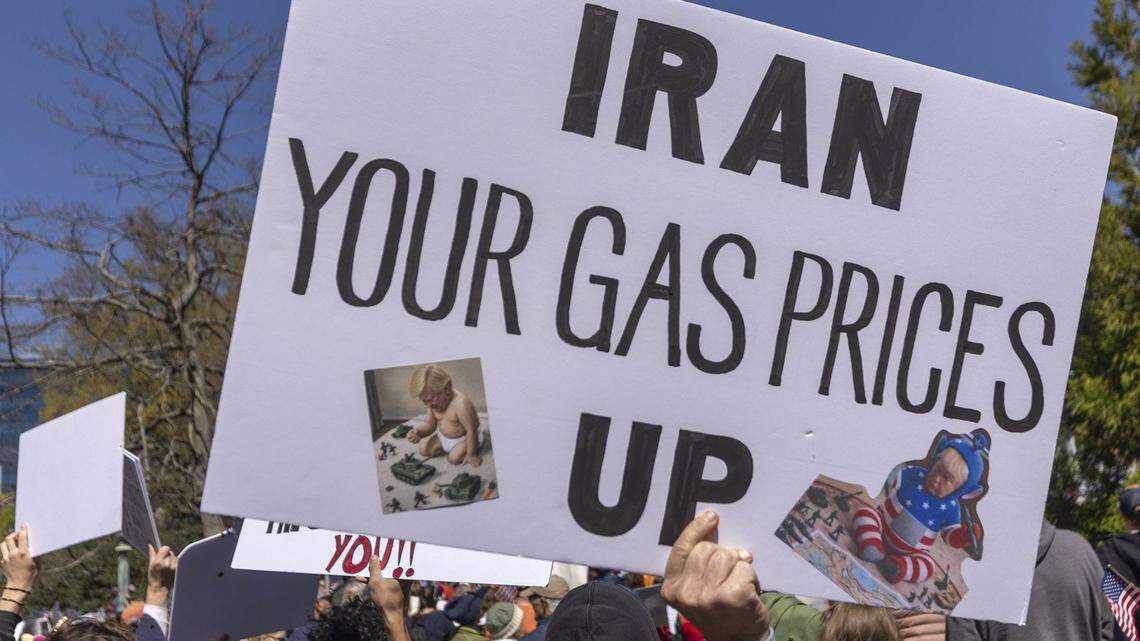
President Trump’s public threats to “destroy” Iran have materially escalated geopolitical risk; U.S. officials report at least 13 U.S. service members killed, more than 520 injured and roughly $800M in damage to bases. North Carolina Democrats are urging Congress to reconvene and pass a War Powers Resolution (Rep. Valerie Foushee called for impeachment), while some Republicans including Sen. Ted Budd publicly backed the president. Energy risks are elevated—U.S. pump prices cited rose from $2.98/gal pre‑war to $4.14/gal—and the political standoff is raising broader market risk-off pressure.
This episode amplifies two transmission mechanisms investors should focus on: near-term risk premia (hours–weeks) priced into oil, shipping, and FX markets, and medium-term fiscal reallocation (months) toward defense and homeland security if Congress ultimately backstops the administration. Short-duration shocks will amplify volatility in Brent and freight rates—spikes above $95–100/bbl or a 10–20% move in charter rates typically trigger immediate flight-to-quality (USD, Treasuries, gold) and transitory hits to discretionary sectors. Over 3–12 months, a credible push for supplemental defense spending or DHS emergency funding would mechanically lift primes’ toplines and services firms tied to logistics and base repairs while squeezing airlines and tour operators through higher jet fuel and insurance costs.
Political fracturing inside the majority creates asymmetric execution risk: Republicans control scheduling, so a swift, large supplemental is possible but by no means guaranteed; failure to deliver funding increases tail risk of escalation without resourcing, which markets dislike. The path to either de-escalation or prolonged conflict hinges on three catalysts within 0–90 days: congressional reconvening and a War Powers vote, visible diplomatic backchannels from key allies, and measurable disruptions to Strait transit or military bases. Cyber and asymmetric tactics are underpriced risks — a credible cyberattack on energy infrastructure would create oil price jumps bigger and faster than conventional supply shocks due to concentrated chokepoints.
Consensus positions are long defense and energy; the overlooked counter is timing and convexity. If the near-term noise fades without additional kinetic events, defense and energy names priced for prolonged war will mean-revert quickly; option structures that buy convexity (calls on defense, puts on travel) or sell early-date premium (calendar structures) will capture that nonlinearity. Position sizing should treat policy outcomes as binary events and cap exposure until after a congressional funding resolution or clear signs of diplomatic de-escalation.
AI-powered research, real-time alerts, and portfolio analytics for institutional investors.
Request DemoOverall Sentiment
strongly negative
Sentiment Score
-0.70
