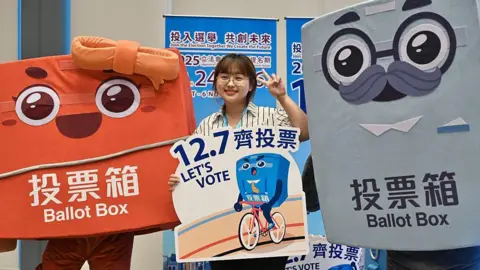
Hong Kong is holding a Legislative Council election seen as a test of public sentiment after a deadly Tai Po high‑rise fire that has killed 159 people; 161 candidates are contesting 90 seats in the second election since Beijing overhauled the system in 2021 to vet candidates for loyalty. The government has mounted an extensive turnout drive — including vouchers, free public services and entertainment — even as authorities investigate the blaze (an independent committee), arrest 13 people on suspected manslaughter charges and detain critics for alleged sedition. The episode raises governance and building‑safety risks that could pressure confidence in Hong Kong’s property sector and political legitimacy, keeping investor sentiment cautious ahead of potential regulatory and reconstruction actions.
Market structure: Short-term winners are companies tied to building remediation, fire-safety equipment and scaffolding/renovation contractors as mandatory retrofits and mesh replacements are ordered; losers are Hong Kong residential developers, property managers and insurers facing reputational, litigation and regulatory cost shocks. Expect localized repricing in HKEq property names (potential -10% to -25% over 1-3 months for most levered names) and modest outflows from HK equity funds if LegCo turnout <35%.
Risk assessment: Immediate risks (days) include low turnout and renewed protests or detentions that dent sentiment; short-term (weeks–months) risks are litigation and mandatory retrofits raising capex 5–15% for exposed landlords; long-term (quarters–years) risk is regulatory tightening on renovation standards and accelerated public housing inspections raising industry compliance costs. Tail scenarios: independent probe finds systemic building-code failures → government bailout/forced buybacks or large legal liabilities for landlords (high-impact, low-probability); watch turnout, inquiry findings, and number of prosecutions as binary catalysts.
Trade implications: Tactical plays: 1) short HK developers (e.g., CK Asset 1113.HK, Sun Hung Kai 0016.HK, Henderson 0012.HK) sized 2–4% NAV for 1–3 months with stop-loss +8% and profit target -15%; 2) buy 3-month 10% OTM puts on EWH (or 2800.HK) as cheap hedges vs sentiment shock; 3) go long HK construction/fit-out suppliers/fire-safety equipment names (2% NAV) for 3–12 months to capture retrofit demand. Rotate out of high-beta Hong Kong consumer discretionary into defensive H-shares/China staples if turnout <35%.
Contrarian angles: Consensus assumes prolonged property pain; underappreciated is rapid government fiscal support and mandated retrofit programs that create multi-quarter revenue for contractors and materials suppliers — a cyclical boost not priced into small-cap contractors. If turnout is modest but <40%, expect targeted fiscal/relief measures (re-housing + reconstruction budgets) that could stabilize property credit spreads; consider stepping into selective long construction names on 15–25% pullbacks.
AI-powered research, real-time alerts, and portfolio analytics for institutional investors.
Request DemoOverall Sentiment
moderately negative
Sentiment Score
-0.45
