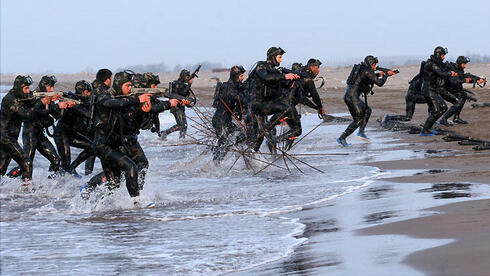
Kuwait alleged that six Iranian Revolutionary Guard members attempted a May 1 infiltration of Bubiyan Island, with four detained and one Kuwaiti security officer wounded. The report also confirmed Israel’s first publicly acknowledged military deployment to the UAE, involving Iron Dome batteries and personnel, underscoring deeper Gulf defense cooperation. The article highlights elevated regional security risk around the Strait of Hormuz and China-linked infrastructure, which could pressure sentiment across Middle East markets.
The market takeaway is not the headline security incident itself, but the widening premium on Gulf logistics and sovereignty risk. A credible threat to a China-linked port node in Kuwait, combined with visible Israeli air-defense support in the UAE, raises the probability that commercial infrastructure in the Gulf increasingly gets priced as a dual-use asset rather than a pure trade asset. That should benefit defense primes, counter-UAS suppliers, and systems integrators with Middle East exposure, while penalizing any transport, port, or industrial name whose earnings depend on uninterrupted Hormuz-adjacent throughput.
The second-order effect is on supply-chain resilience spending. Gulf states now have a stronger incentive to buy layered air defense, maritime surveillance, hardened communications, and point-defense for ports and energy facilities; this is a multi-quarter capex cycle, not a one-off response. The broader loser is China’s BRI narrative in the region: if Beijing cannot meaningfully de-risk its own infrastructure projects, Gulf partners may diversify toward Western and Israeli security architectures, which is incrementally supportive for U.S./European defense ecosystems.
Near term, the risk is escalation through miscalculation rather than a full conventional conflict. The market tends to underprice tail events over days and weeks, but the re-rating can be sharp if there is a second attack, a shipping disruption, or a breakdown in U.S.-Iran talks over the next 1-3 months. Conversely, this trade can reverse quickly if there is visible de-escalation or if Gulf states frame the incident as isolated rather than systemic, so timing and optionality matter.
The contrarian view is that the move may be underdone in defense but overdone in broad EM risk. Not every GCC asset deserves a geopolitical discount; the real differentiation is between assets directly exposed to chokepoints and those with policy-backed security umbrellas. The best expression is to own the beneficiaries of higher security spend rather than short the region wholesale.
AI-powered research, real-time alerts, and portfolio analytics for institutional investors.
Request DemoOverall Sentiment
mildly negative
Sentiment Score
-0.35
