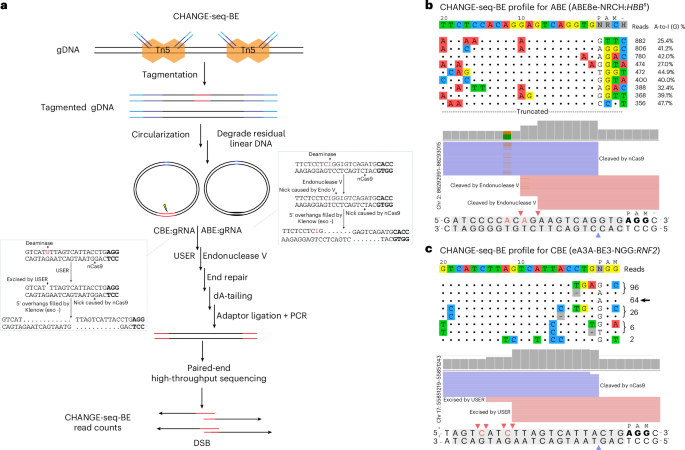
Researchers report CHANGE-seq-BE, a sensitive and unbiased biochemical method to profile genome‑wide, gRNA-dependent off-target activity of adenine and cytosine base editors. The method validated all 54 previously known ABE8e off-target sites for an HBB gRNA, discovered 29 additional bona fide off-targets (≈53% more), showed ABE8e produces substantially more off-target activity than Cas9 (98.8% of validated sites were unique to ABE8e), and is ~20-fold more sequencing-efficient than Digenome-seq (~25M reads/sample). CHANGE-seq-BE also flagged contaminating synthetic gRNAs that produced measurable unintended editing and was used to support an emergency IND for personalized ABE therapy, identifying 81 candidate off-targets and confirming ~95% on-target correction with no off-targets above detection thresholds.
Market structure: CHANGE-seq-BE raises the bar for unbiased, sensitive off-target profiling and creates immediate demand for specialized assays, computational pipelines and qualified QC workflows. Winners are sequencing platform and clinical‑grade assay providers (higher-margin CRO work, assay licensing) and vendors of high‑fidelity base‑editor proteins; losers are pure‑play ABE therapeutics without validated safety platforms, and low‑quality synthetic gRNA suppliers susceptible to contamination. Net sequencing-volume effect is ambiguous: per-assay reads fall (~20x) but assay count per IND candidate and regulatory-driven repeat testing likely rises >5× over 12–24 months, favoring diversified sequencing and service providers.
Risk assessment: Tail risk centers on regulatory action — an FDA/EMA directive requiring biochemical off‑target assays (CHANGE-seq-BE or equivalent) for INDs could force extra studies, delaying approvals and causing 20–50% mark‑to‑market losses for small-cap therapeutics in 30–180 days. Hidden dependencies include access to high‑quality purified editors and HPLC sequencing practices (gRNA cross‑contamination) that can create false positives/negatives; supply disruptions or vendor recalls would amplify downside. Catalysts: rapid academic/industry adoption, FDA guidance within 1–6 months, or a high‑profile adverse clinical signal.
Trade implications: Tactical long bias to diversified sequencing/CRO names (Illumina, ILMN) over 6–12 months; consider 2–3% portfolio exposure with a bullish options overlay (6–12 month call spread). Short/underweight selective small-cap ABE‑centric therapeutics lacking validated off‑target plans (size 1–2% portfolio) — they carry asymmetric downside if regulators act. Use protective puts (3‑6 month, 5–10% OTM) on concentrated gene‑editing positions to hedge a regulatory shock.
Contrarian angles: Consensus may overstate permanent damage to all gene‑editing — high‑fidelity editors, hybrid gRNAs and firms that integrate CHANGE-seq-BE into devops will be re‑rated positively; this bifurcation can create mispricings. Historical parallel: 2018 CRISPR off‑target scares produced a 20–40% drawdown that reversed as measurement and engineering improved — expect similar rotation over 12–24 months. Unintended consequence: heightened safety scrutiny will expand addressable market for validation/CRO services more than it shrinks therapeutic valuations long term.
AI-powered research, real-time alerts, and portfolio analytics for institutional investors.
Request DemoOverall Sentiment
neutral
Sentiment Score
0.15
Ticker Sentiment
