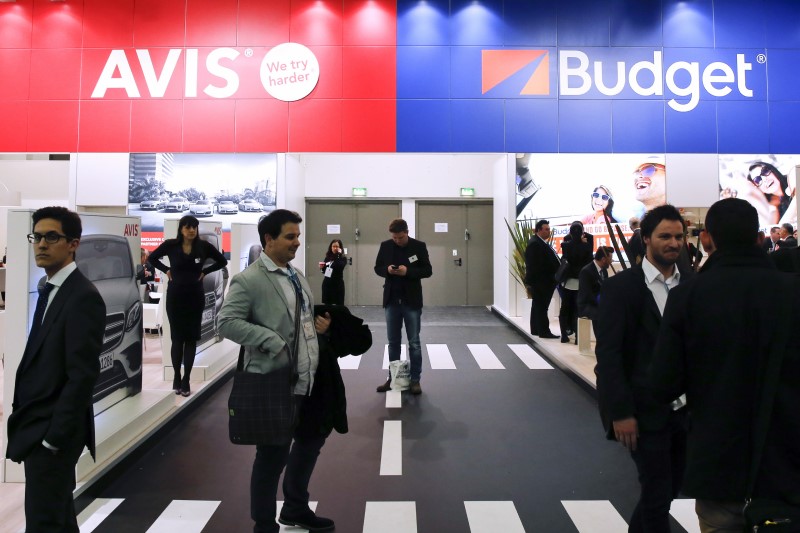
Avis Budget (CAR) announced an at-the-market equity offering program to sell up to 5.0 million shares, prompting a 3.3% share decline. The company may pay sales agents up to a 2.00% commission, filed a shelf registration on Form S-3ASR and a prospectus supplement with the SEC, and said net proceeds would be used for general corporate purposes; the offering can be suspended and carries no obligation to sell.
The corporate decision to create optionality around equity supply creates an immediate technical overhang that disproportionately hurts highly levered, low-liquidity names in the travel/leisure complex. Banks that took the deal (MS, JPM, BAC) collect fees and can warehouse paper — reducing their incentive to push price support — so look for muted buybacks or secondary-market stabilisation versus past issuance cycles. Competitors with cleaner balance sheets (public peers like HTZ) should see relative inflows as allocators rotate away from idiosyncratic funding risk into purer operating stories.
Near-term risk is concentrated in market technicals: increased share availability tends to drive 30–90 day underperformance through both systematic reweighting and margin/prime-broker reactions; expect amplified volatility around each drip-sale tranche. Medium-term catalysts that would reverse the move are concrete demand beats (strong summer travel metrics, sustained pricing power) or an explicit suspension/expiry of the supply program — both would compress implied volatility and squeeze short positions. Tail risks include accelerated issuance into a weak revenue print or contagion to fleet financing spreads if lenders perceive dilution as a stress signal.
Practical trades should separate the liquidity/dilution story from the operating leisure rebound. Short-duration strategies capture the overhang and volatility premium; longer-dated, directional trades should be sized only when paired against peers or when backed by macro demand indicators. Monitor used-car wholesale trends and wholesale financing spreads as second-order data that will drive fleet economics and therefore fair multiples over 3–12 months.
Contrarian nuance: the move is not an admission of insolvency but of optionality — management retains flexibility to deploy equity either defensively or opportunistically, which caps downside if travel demand reaccelerates. This makes a two-legged approach (short near-term equity/IV and buy longer-dated call optionality) attractive for asymmetric payoff without being purely momentum-driven.
AI-powered research, real-time alerts, and portfolio analytics for institutional investors.
Request DemoOverall Sentiment
mildly negative
Sentiment Score
-0.20
Ticker Sentiment
