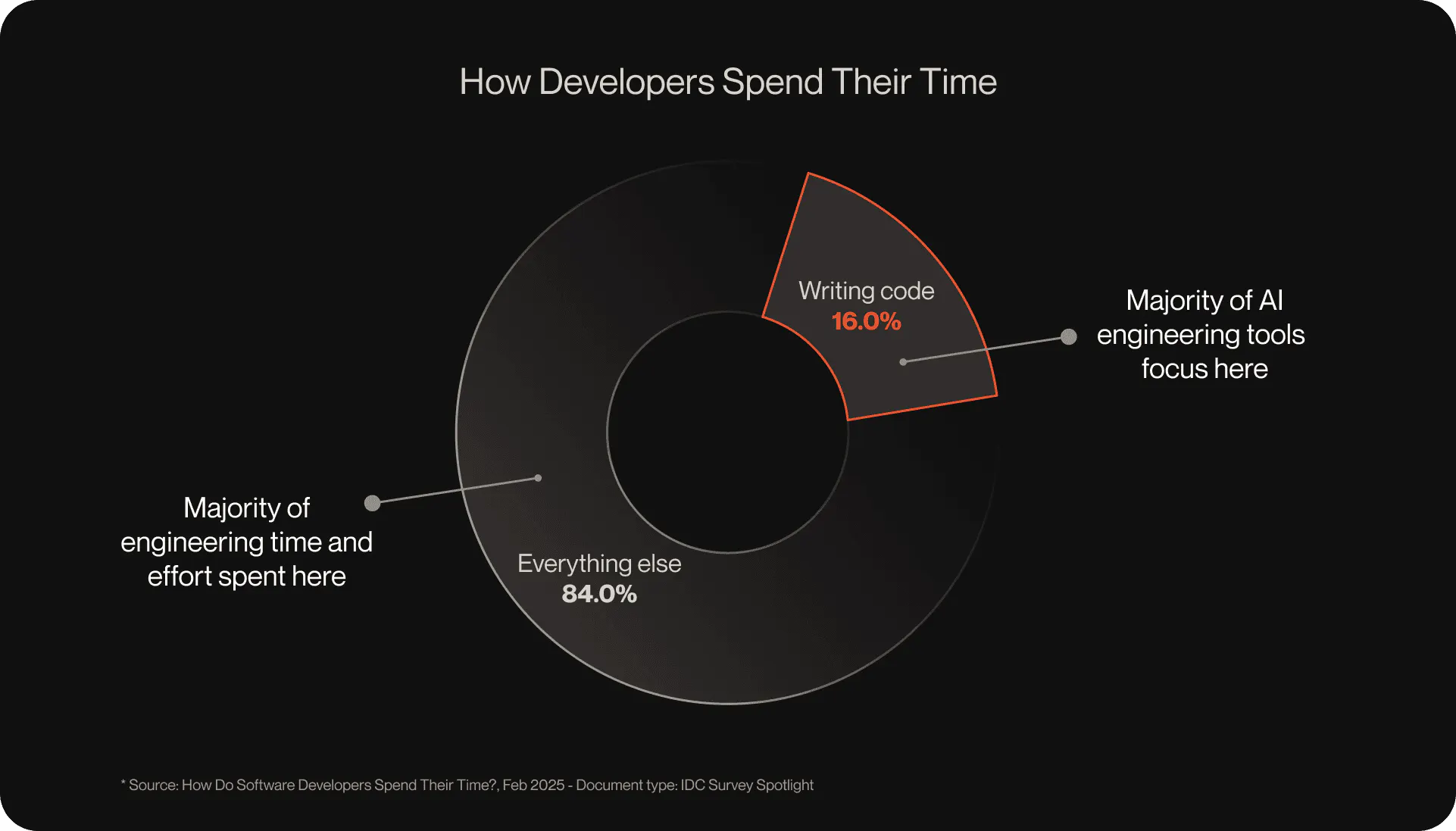
Google reports AI assists in writing ~50% of its code and Microsoft ~30%. A Stack Overflow survey found 45% of developers say debugging has become more time-consuming, and some studies suggest AI use can slow teams by almost 20%. The article argues AI excels at rapid code generation (prototyping) but struggles with operationalization—testing, deploying, and debugging—limiting near-term productivity gains and implying continued maintenance cost and time pressures until tools address the latter half of the SDLC.
The real margin shift we should be watching is budget reallocation inside engineering teams: expect 5–15% of developer cycles and associated headcount dollars to migrate from pure feature delivery into observability, SRE automation, and forensic tooling over the next 12 months. That reallocation will be driven not by feature demand but by the need to reduce mean time to resolution (MTTR) and to create repeatable, instrumented paths from prototype to production — a cost that is largely opaque today.
This implies divergent winners: vendors that can bundle forward-generation and reverse-engineering workflows — think code provenance, telemetry-first CI/CD, and agentic incident playbooks — will capture outsized growth; pure-play code generators without ops integration will see adoption plateau. At the corporate level, firms with end-to-end control of the dev toolchain and enterprise go-to-market (faster cross-sell into large accounts) have a structural edge in converting this new spend into high-margin cloud and platform revenue.
Catalysts to watch: major multi‑service outages tied to AI-generated components (weeks), vendor releases that integrate runbook automation into the IDE (3–9 months), and measurable MTTR improvements from pilot deployments (6–18 months). Tail risk is rapid model improvement in causal reasoning/debugging that collapses the current asymmetry; in that case, feature-velocity wins reassert themselves and the observability reallocation reverses.
AI-powered research, real-time alerts, and portfolio analytics for institutional investors.
Overall Sentiment
mildly negative
Sentiment Score
-0.25
Ticker Sentiment
