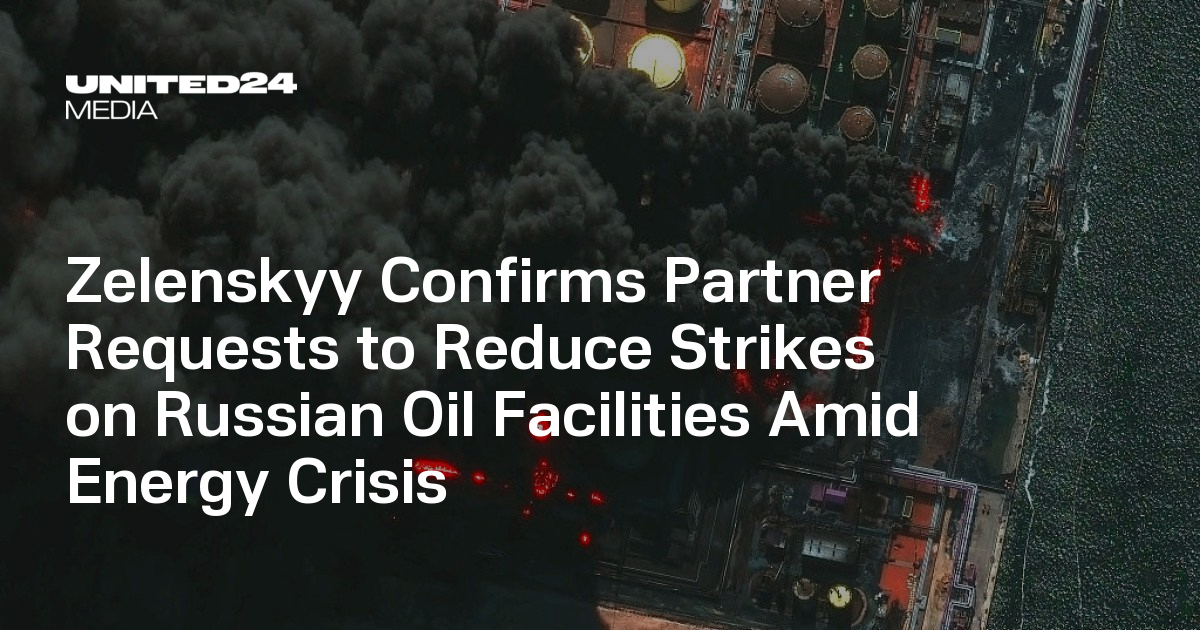
At least 40% of Russia’s oil export capacity is reportedly at a standstill after an intensified Ukrainian drone campaign targeting Baltic export hubs (Ust-Luga, Primorsk). President Zelenskyy said partners have asked Ukraine to scale back strikes amid a global energy crisis and proposed a reciprocal ‘energy ceasefire,’ but Ukraine will continue to respond until a verifiable mutual agreement is reached. The disruption, combined with Middle East tensions and Strait of Hormuz closures, is adding material strain to global energy markets and logistics.
The market is trading a binary path: a credible, verifiable energy “de-escalation” would relieve immediate premium drivers (insurance, war-risk surcharges, voyage diversions) and compress front-month crude and product spreads within weeks; failure to secure such an agreement preserves elevated basis volatility and forces longer voyage arcs that mechanically raise freight and bunker costs. Expect the clearest second-order winners from a ceasefire to be European refiners that run on cheaper, shorter-haul crude (faster turnaround on cargo arbitrage) and airlines/transporters that are most sensitive to near-term jet/diesel cracks. Conversely, continued targeting keeps upward pressure on short-cycle players — tanker owners, oil storage providers, and commodity traders that monetize backwardation through time spreads.
Risk timing is skewed: days-to-weeks determine freight and prompt crack moves (insurable windows and re-routings), while months determine inventory rebuild and refining margins as crude flows re-seat into long-term arbitrage lanes. Key reversals will come from four catalysts: rapid, verifiable mutual ceasefire language; coordinated SPR releases or producer output responses; insurance market readjustment (war-risk premiums falling materially); or a major buyer quietly re-entering sanctioned flows, which would mute price moves. Watch derivative term structure: a sustained steepening of front-month/back-month spreads signals persistent operational friction rather than transient headline risk.
Implementation should be asymmetric — buy optionality on continued disruption while monetizing premium compression scenarios. Position sizing should treat this as an event with >30% probability of short-term resolution but >25% tail risk of renewed escalation; hedges must be liquid and short-dated to avoid theta bleed if the market calms quickly.
AI-powered research, real-time alerts, and portfolio analytics for institutional investors.
Request DemoOverall Sentiment
strongly negative
Sentiment Score
-0.60
