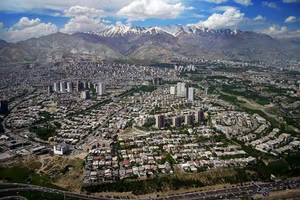
President Masoud Pezeshkian said Iran must move its capital because severe ecological strain has made Tehran unsustainable, warning of acute water shortages and significant land subsidence (he cited figures as high as 30 cm) and calling the relocation an obligation. The government is studying a shift to the southern Makran coast—announced in January—to relieve overcrowding, energy shortfalls and water stress and to leverage the Chabahar port, but the remote region is underdeveloped, exposed to security risks and would likely cost tens of billions of dollars amid economic strain, high inflation and renewed UN sanctions. Pezeshkian acknowledged costly options such as desalination, urged cross‑government coordination, and underscored that while environmental pressures make relocation urgent, the plan faces major fiscal, political and logistical hurdles.
President Masoud Pezeshkian declared that relocating Iran’s capital has become an obligation as Tehran faces acute ecological strain, citing shrinking water supplies, infrastructure stress and land subsidence figures referenced in the article of up to 30 centimeters (with a quoted warning that subsidence was occurring at an even more alarming cadence). He acknowledged prior financial constraints—"we did not even have enough budget"—and flagged desalination from the Persian Gulf as technically possible but costly, underscoring the scale of the fiscal challenge.
The government is studying a move to the southern Makran coast to relieve overcrowding, energy shortfalls and water stress and to leverage Chabahar port, but the article stresses the region is underdeveloped, exposed to security risks and distant from existing governance centers. Past relocation proposals stalled for political resistance and cost; officials and critics alike estimate the shift would likely require tens of billions of dollars amid high inflation and renewed UN sanctions.
Market signals attached to the report show a moderately negative sentiment score (-0.6) and a modest market impact score (0.35), implying reputational and fiscal risk to Iran-focused assets and prospective long-dated infrastructure commitments, while near-term market disruption outside regional or sovereign exposures appears limited.
AI-powered research, real-time alerts, and portfolio analytics for institutional investors.
Request DemoOverall Sentiment
moderately negative
Sentiment Score
-0.60
