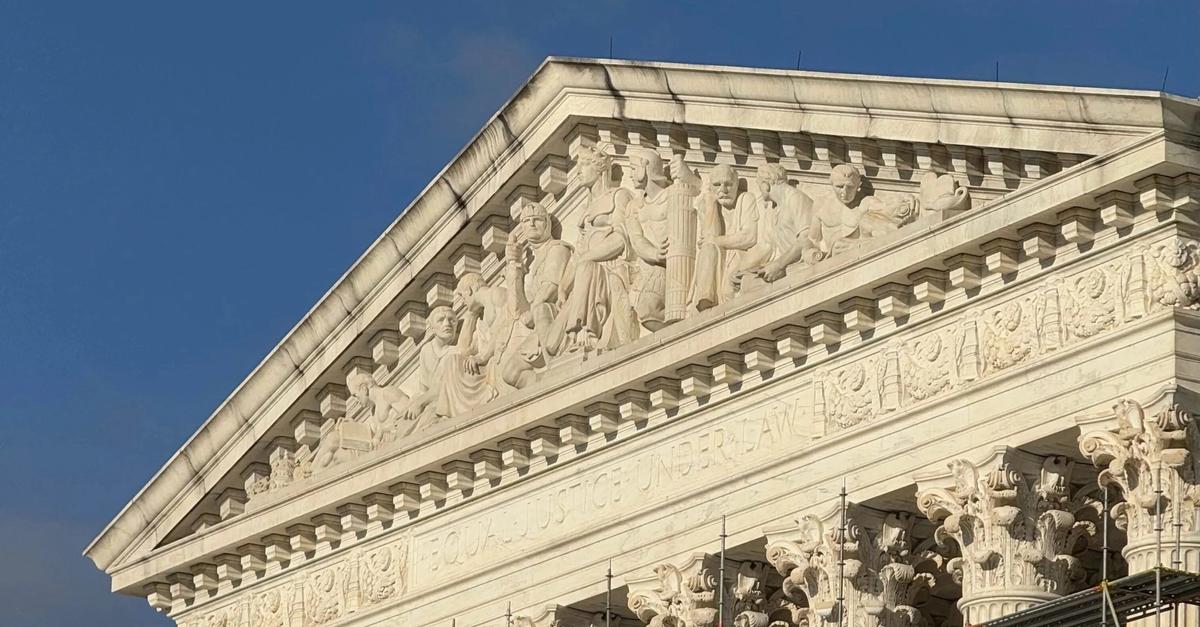
The Supreme Court cleared Alabama to use its 2023 congressional map, vacating a lower-court ruling that had blocked it under Section 2 of the Voting Rights Act. The court also extended Samuel Alito’s temporary stay, keeping mifepristone available by mail at least until 5 p.m. EDT Thursday, May 14, and Virginia separately asked the court to let it use a new congressional map for the 2026 elections. Separately, the article highlights ongoing tariff litigation, including Trump’s criticism of Justices Gorsuch and Barrett after a ruling against his tariffs.
The immediate market read is not about any single case outcome, but about the Court’s growing willingness to use emergency procedure as a policy-shaping tool. That raises the volatility premium around regulated sectors because the legal path now matters almost as much as the merits: a temporary stay can preserve business models for days or weeks, while a remand or vacatur can reprice cash flows over quarters. The bigger second-order effect is that companies with revenues exposed to federal rules now face a longer “decision tree” discount, which should support litigation-sensitive legal services demand but compress multiples for firms whose economics depend on stable regulatory assumptions. The Alabama and Virginia redistricting moves matter less for the maps themselves than for what they signal about election-law durability ahead of the 2026 cycle. A higher likelihood of map churn and court intervention increases the probability of late-stage filing deadlines, candidate uncertainty, and advertising inefficiency; that tends to benefit data/consulting and media sellers with flexible inventory while hurting localized campaign spend planning. The market should also expect more donor caution in jurisdictions where control of the House could swing on a handful of seats, which can subtly depress early-cycle political ad commitments. On healthcare, the extension around mifepristone is a short-dated relief rally for pharmacy-adjacent and telehealth-adjacent exposure, but it is still only a pause, not a resolution. The key risk is not the next 72 hours; it is that the Court’s posture leaves the entire medication-abortion supply chain in a recurring headline loop, which raises compliance costs and may force distributors to re-run scenario planning for in-person dispensing at scale. Contrarian take: the headline risk is overdiscussed relative to actual near-term access, but underdiscussed relative to the structural chilling effect on new reproductive-health product launches. For tariffs, the Court’s apparent willingness to constrain executive improvisation raises the odds that the administration shifts from broad, fast-moving tariffs toward narrower, slower, litigation-tested regimes. That is bearish for companies that have benefited from opaque tariff shelter and bullish for import-heavy retailers and industrials that need predictability more than protection. The risk is that policy simply reappears through a different statutory lane, which would keep uncertainty elevated but could favor firms with diversified sourcing and pricing power.
AI-powered research, real-time alerts, and portfolio analytics for institutional investors.
Request DemoOverall Sentiment
neutral
Sentiment Score
-0.05
Ticker Sentiment
