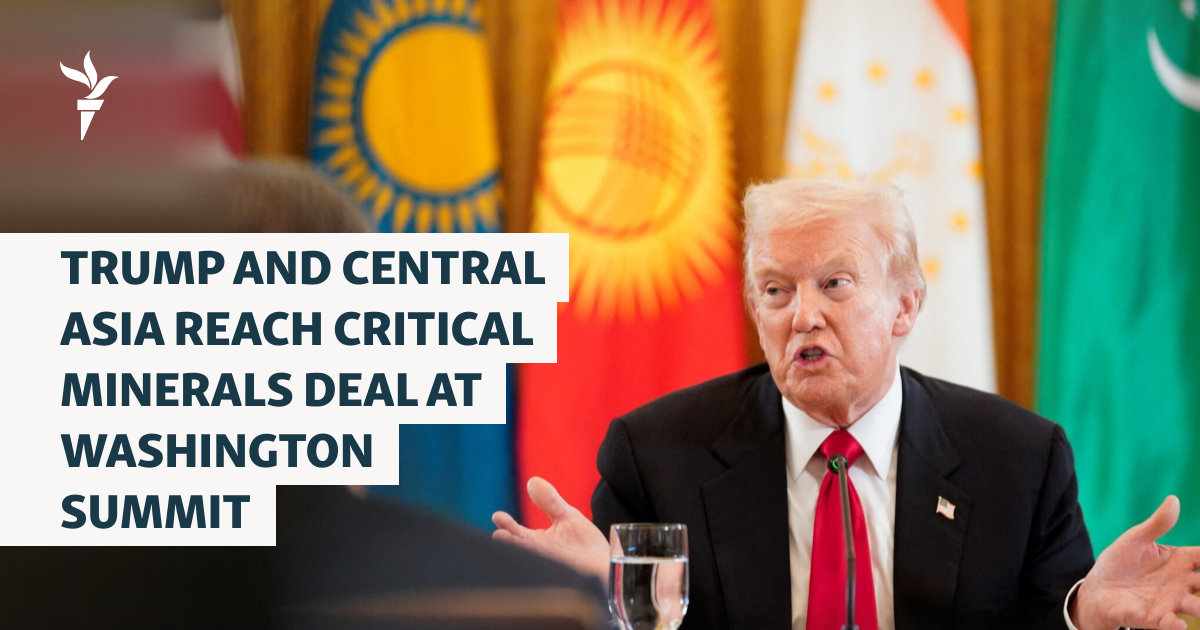
The US hosted Central Asian leaders, unveiling significant economic and strategic initiatives aimed at bolstering American influence and diversifying critical mineral supply chains. Key outcomes include a $1.1 billion joint venture for a major tungsten deposit in Kazakhstan with US firm Cove Kaz Capital Group, backed by a $900 million Ex-Im Bank letter of interest, alongside over $17.2 billion in other agreements with US companies and potential Boeing jet sales. This engagement signals a strategic pivot by Central Asian nations to leverage their critical mineral wealth for deeper US ties, counterbalancing Russian and Chinese dominance, and expanding US-led diplomatic frameworks like the Abraham Accords, with proposed legislation to repeal Cold War-era trade restrictions further facilitating Western investment.
The recent US-Central Asia summit yielded significant economic and strategic agreements, signaling a renewed US commitment to the region. Kazakhstan announced a $1.1 billion joint venture with US firm Cove Kaz Capital Group for a major tungsten deposit, with the US Ex-Im Bank providing a $900 million letter of interest. Additionally, Kazakhstan secured over $17.2 billion in other agreements with US companies and a potential deal for up to 37 Boeing jets for regional airlines.
These initiatives underscore a strategic pivot by Central Asian nations to diversify away from Chinese and Russian dominance, leveraging their substantial critical mineral wealth. The tungsten deal, specifically aimed at preventing Chinese development, highlights US efforts to secure supply chains for essential materials like rare earths, copper, and uranium, vital for national security and the green energy transition. China currently controls 70% of global rare earth mining and 90% of processing, making Central Asian diversification crucial.
The summit also saw Kazakhstan express intent to join the Abraham Accords, expanding the US-led diplomatic framework into a pro-US coalition of Muslim nations. Concurrently, bipartisan legislation has been introduced to repeal Cold War-era Jackson-Vanik trade restrictions, aiming to facilitate increased US investment in the region. This legislative push addresses structural barriers and Chinese/Russian capital dominance identified by CSIS, which currently deter Western engagement.
AI-powered research, real-time alerts, and portfolio analytics for institutional investors.
Request DemoOverall Sentiment
moderately positive
Sentiment Score
0.65
Ticker Sentiment
