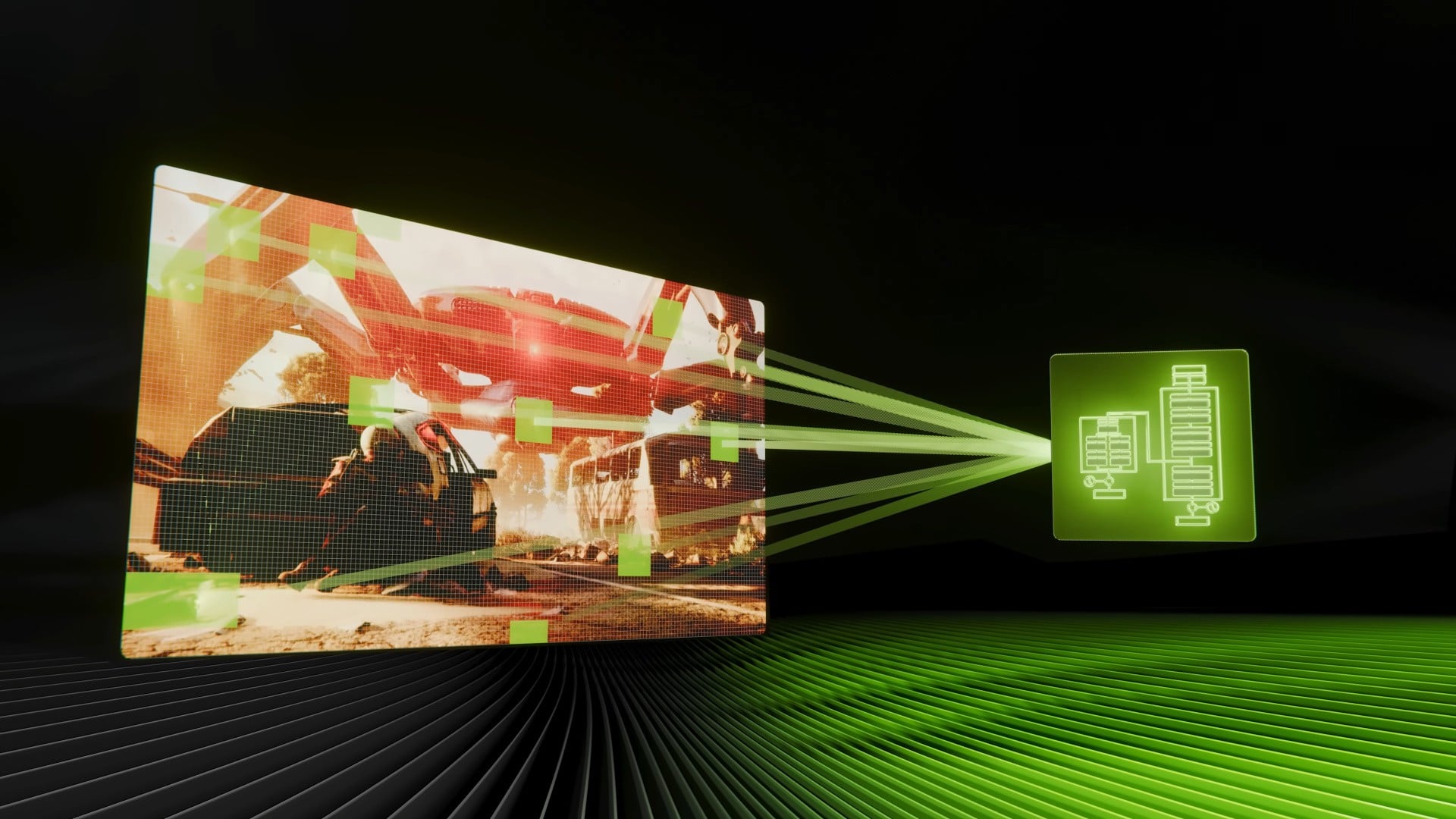
Nvidia showcased DLSS 4.5 (new Preset M and L transformer models) and Dynamic Multi-Frame Generation (DMFG) ahead of CES, highlighting visual improvements alongside measurable performance costs: DLSS K-to-M on an RTX 5090 rises from 0.87ms to 1.05ms (+20.7%), can jump ~39% on an RTX 4070 Ti, and exceeds a 200% time increase on some RTX 2000/3000 GPUs (e.g., RTX 3080 Ti K: 2.06ms → M: 4.35ms). DMFG (Spring 2026) adds ~4–6ms input latency dynamically and will initially be RTX 5000-series exclusive; additional product news includes Pragmata path tracing (PC launch April), local small-language-model game assistants (requiring ~6GB VRAM in one test, 2GB in another), confirmation of continuous RTX 3060 production, and no planned price changes to Nvidia Founders Edition cards — all factors that may influence GPU demand segmentation and upgrade cycles but are unlikely to be market-moving on their own.
Market structure: Nvidia (NVDA) is the clear winner—DLSS 4.5 and DMFG create a hardware-dependent moat that increases pricing power for Ada/Blackwell GPUs (RTX 4000/5000), likely supporting ASPs and replacement demand over the next 12–24 months. Losers: legacy GPU makers and owners of older RTX 2000/3000 hardware (and some AMD/Intel parts) face weaker perceived value because Preset M/L run >2x slower on older silicon, fragmenting demand and pressuring used-GPU supply downward by an estimated 5–15% on refresh cycles. Cross-asset: stronger NVDA equity performance should tighten IG tech credit spreads marginally and buoy TSM/ASML capex expectations; USD could gain modestly on widening US tech outperformance, while copper/silicon wafer prices get positive demand signals.
Risk assessment: tail risks include US/China export controls or antitrust action (6–18 month horizon) that could cut China revenue by >10% of NVDA sales, and model/regression failures in DLSS that spur negative gamer/media feedback cycles. Short-term (days–weeks): CES sentiment and Pragmata April demo will move IV and flows; medium-term (months): Spring 2026 DMFG exclusivity may slow adoption if developers resist vendor lock-in. Hidden dependencies: game developer uptake, VRAM thresholds (2–6GB for different features) and OEM pricing decisions are key second-order levers; catalyst calendar: Pragmata April, DMFG Spring 2026, NVDA earnings.
Trade implications: establish a 2–4% long NVDA equity position sized to risk tolerance and ladder into April and Spring 2026 catalysts; complement with a 6–9 month call spread to cap cost (example: buy 6-mo NVDA 10% ITM calls and sell 20% OTM calls). Pair trade: long NVDA/short AMD (AMD) 1:1 for 3–9 months anticipating margin premium for NVDA in AI/RTX, sizing combined exposure to 2% net portfolio. If IV >45% into catalysts, prefer debit call spreads or 12–18 month LEAPS (buy Jan 2027 5–10% ITM calls) and sell shorter-dated OTM calls to fund. Rotate modest overweight into wafer-capex names (TSM, ASML) for 6–18 month play on sustained GPU demand.
Contrarian angles: consensus underestimates fragmentation risk—high-quality DLSS features requiring newer GPUs may cap TAM growth if consumers delay upgrades; if adoption lags, NVDA shares could retrace 10–20% from current levels. The market may also be underpricing the used-GPU tail: a 10–20% increase in secondary supply could pressure new-unit ASPs. Historical parallel: post-cycle crypto GPU glut in 2019 shows how demand shocks can flip supply economics quickly. Set explicit triggers: trim longs if NVDA outperforms by +25% pre-April or if retail sell-through rates fall >15% vs. sell-in figures reported by OEMs.
AI-powered research, real-time alerts, and portfolio analytics for institutional investors.
Request DemoOverall Sentiment
mildly positive
Sentiment Score
0.32
Ticker Sentiment
