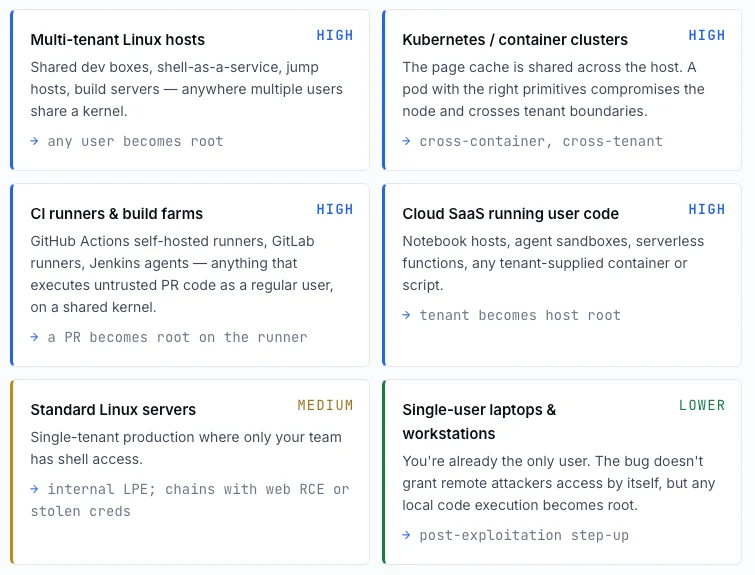
Theori disclosed CVE-2026-31431, a high-severity Linux kernel local privilege escalation flaw that can let an unprivileged user write 4 controlled bytes into the page cache and gain root. The issue affects virtually every major Linux distribution shipped since 2017, with verified vulnerability on Ubuntu 24.04 LTS, Amazon Linux 2023, RHEL 10.1, SUSE 16, and Rocky Linux 9.7. While not remotely exploitable on its own, the publicly available PoC and container breakout risk make patching urgent for multi-tenant systems, CI runners, and cloud workloads.
This is less a one-off Linux bug than a broad re-pricing event for any business that assumes “user-level access” is a contained blast radius. The second-order risk is not just endpoint compromise; it’s lateral movement from low-privilege footholds into CI/CD, build agents, container hosts, and shared SaaS workloads where a single local escalation can turn transient web or vendor access into full environment control. That disproportionately raises expected loss for multi-tenant and workflow-heavy operators, even if they have no direct Linux product exposure. The market impact is likely front-loaded over days to a few weeks as security teams triage, but the real earnings effect compounds over 1-2 quarters through emergency patching, downtime, audit friction, and accelerated hardening spend. Vendors selling Linux-based enterprise software, cloud management, endpoint detection, and container security should see budget pull-forward; the hidden loser is anyone whose gross margin depends on low-touch deployment and high uptime, because patch coordination across fleets creates operational drag that is hard to quantify until incidents stack up. The contrarian read is that the headline severity may be overstated for mature enterprises with tight privilege separation and rapid kernel management, while underestimating the tail risk for smaller cloud-native operators that run user-supplied code. The issue is not ubiquitous catastrophic breach; it is that the exploit is cheap, reliable, and reusable, which lowers attacker cost and likely increases commoditization of exploitation inside existing intrusion chains. That makes the most vulnerable cohort the least sophisticated one, and the damage curve could look more like a steady increase in incident frequency than a single event-driven shock. For public markets, the cleanest expression is to favor security vendors with Linux/container exposure and avoid names where SaaS uptime or cloud workload trust is a core value prop until patch adoption is confirmed. The catalyst window is immediate: expect heightened scanning and follow-on disclosures within 1-3 weeks, then broader budget impacts into the next earnings season as management teams are forced to explain remediation spend and customer churn risk.
AI-powered research, real-time alerts, and portfolio analytics for institutional investors.
Request DemoOverall Sentiment
strongly negative
Sentiment Score
-0.65
